
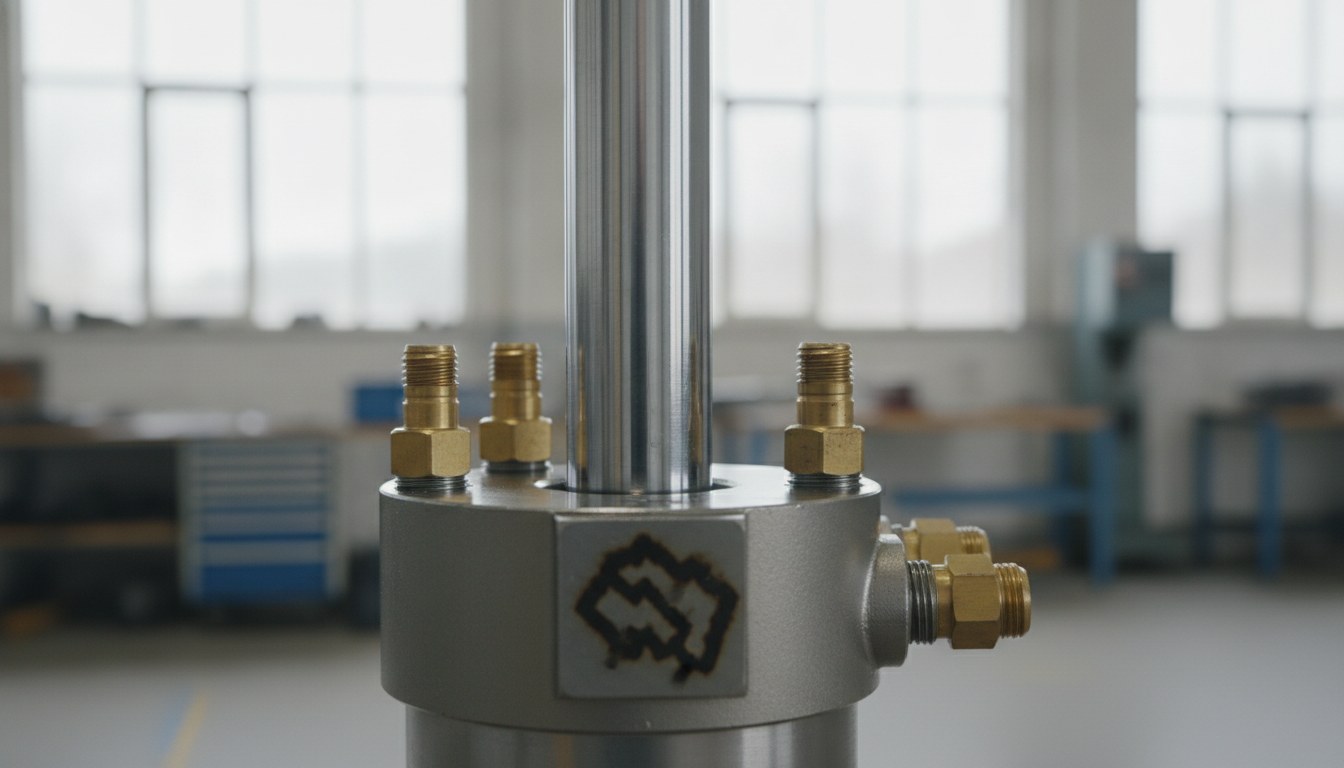
Anyone who manufactures hydraulic cylinders, power units, and fittings knows the moment when identification becomes a problem: the component is assembled, tested, ready to ship, and right at that point you have to apply the serial number, nameplate data, and traceability code. The nameplate is the traditional choice, but on a body that operates immersed in oil, amid vibration and thermal cycles, it doesn’t always hold up — and in several specifications it isn’t even permitted, whether for reasons of space, tamper resistance, or because the reference surface is the rod itself.
Direct fiber marking solves the problem at its root, because it writes the information onto the metal and not onto a carrier that can come off. But applying it to an already assembled component means thinking through two constraints that no data sheet resolves on its own: access to the surface to be marked and the risk of circuit contamination. It’s these two points, not the power of the source, that decide whether the project works.
Why the nameplate doesn’t always hold up in hydraulics
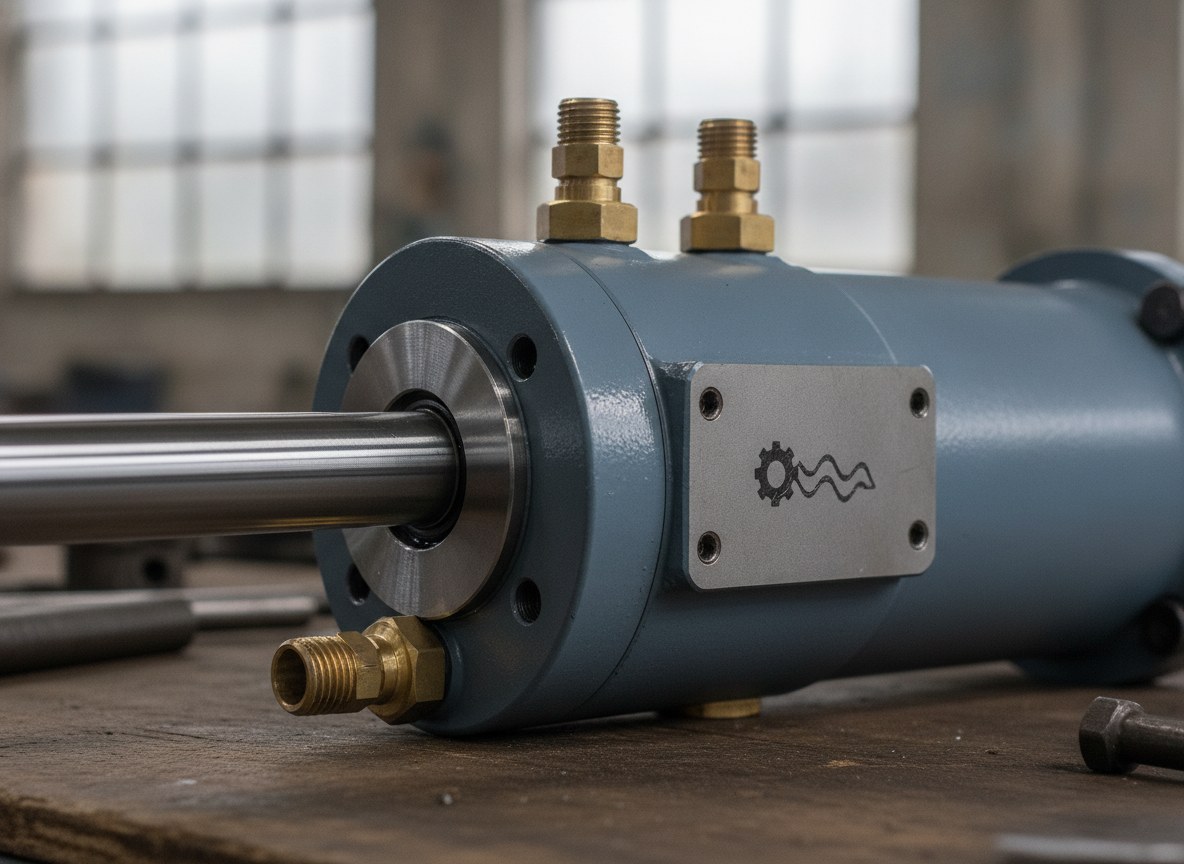
An applied nameplate is an added component, and like any added component it has a way of failing. Adhesives give way under prolonged contact with mineral oils and hydraulic fluids; riveted or crimped nameplates can loosen under vibration; the thermal cycle between start-up and operating temperature fatigues both the adhesive and the mechanical interface. The result is the loss of the reference precisely when you need it: during service, a return, or the analysis of a failure.
Then there’s the matter of space. On a fitting, a head, or a compact cylinder the available flat surface is minimal, and a nameplate takes up usable area that often isn’t there. In other cases it’s the customer’s specification that requires the data to be engraved on the body, to ensure that identification and component remain one and the same throughout the life of the part. Direct marking was created for exactly this scenario: it makes the data inseparable from the metal.
Direct fiber marking on steel and chrome-plated surfaces
The 1064 nm fiber source is the natural choice on hydraulic metals: it marks carbon steels, stainless steel, brass, and treated surfaces with a single type of machine, adapting the result to the material. On these components the decisive variable isn’t what you can write, but how you write it without compromising the functional surface.
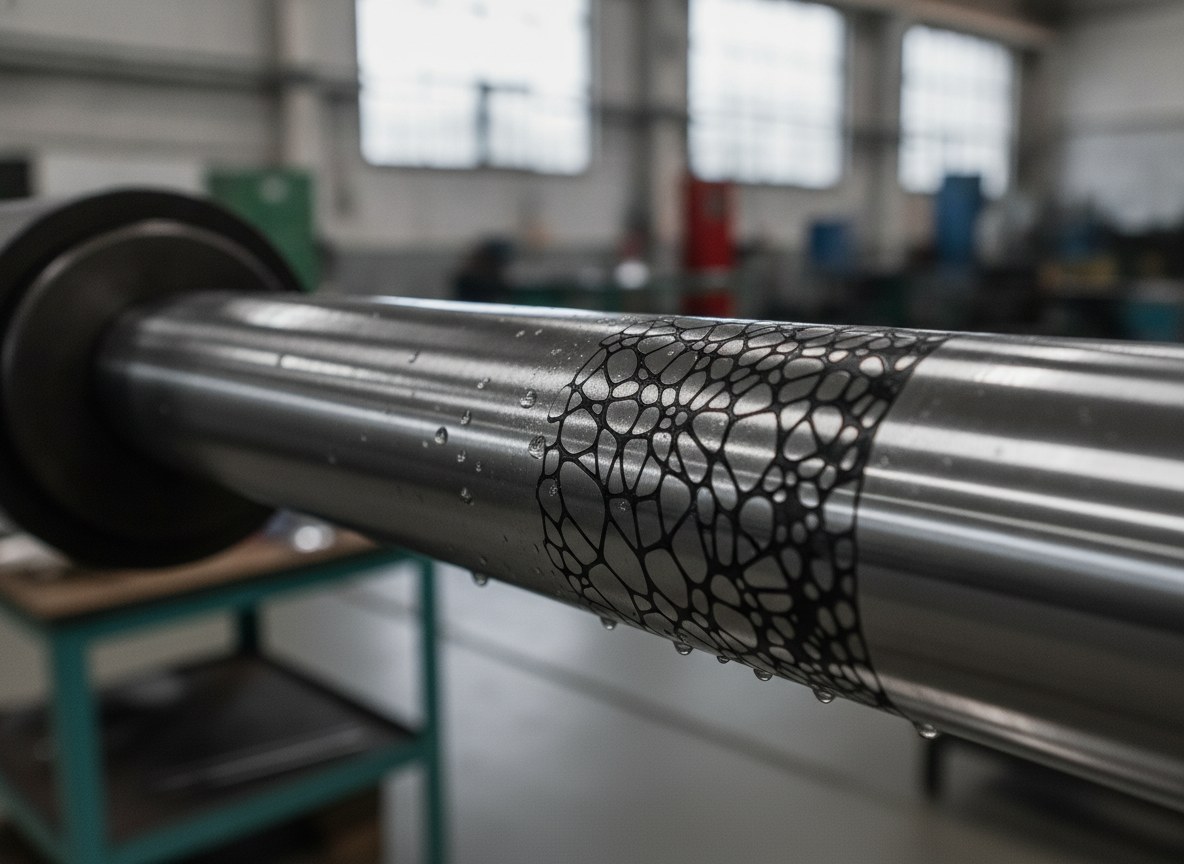
On a chrome-plated rod the issue is clear-cut. The hard chrome layer, often just a few microns thick, is what protects the rod from corrosion and from wear caused by the seal pack: engraving deep into it means opening a path to corrosion right in the sliding zone. That’s why, where the surface is critical, annealing marking is preferred: the beam heats the metal below the melting threshold and generates a stable dark contrast without material removal, leaving the surface intact. True engraving, on the other hand, remains suited to bodies and heads, where a deeper mark improves legibility and abrasion resistance without touching sealing areas.
The access constraint: marking without disassembly
On an assembled component you can’t bring the part to the machine as you do on a line: it’s the marking head that has to be brought to the part. Here what matters is the working distance and the depth of field of the optical system, which must be sufficient to reach surfaces recessed among flanges, fittings, and ports without collisions and while keeping proper focus.
On cylindrical bodies — rods, tubes, bushings — the problem is curvature. Marking over a wide field on a round surface distorts the characters and disperses power density at the edges; that’s why a rotary axis is used to turn the part while keeping the beam always perpendicular to the surface, so the marking stays uniform all around the circumference. Where the geometry is irregular or angled, a 3D head makes it possible to follow the profile without moving the component, as already happens with marking on curved and irregular surfaces. The common principle is just one: adapt the system to the assembled part, not the other way around.
The risk of particulate and circuit contamination
Marking a component already connected to a hydraulic circuit introduces a risk that doesn’t exist on a line: particulate. Any process that removes material generates debris, and in hydraulics a micro-contamination that enters an open port can damage seals, valves, and sliding surfaces. That’s why the choice of marking process, in this context, is also a choice about cleanliness.
Direct marking on an assembled component without contaminationMask portsPosition rotary axisAnneal markingFume extractionCode gradingAnnealing marking is advantageous here too, because it removes no metal and therefore produces no solid debris. Where engraving is needed, control is achieved by combining localized fume extraction with masking or the temporary closure of the ports and connections near the marking zone. In many cases the safest solution remains marking the components before the circuit is closed, reserving in-situ marking for those cases alone where the data must be applied to the finished assembly.
Direct marking or nameplate: an honest comparison
Direct marking doesn’t make the nameplate obsolete: they are two tools with different logics. Direct marking is permanent, doesn’t come off, isn’t bothered by oils or thermal cycles, and ties the data to the part; it does, however, require a suitable, accessible surface and enough flat space for the code. The nameplate carries far more information, can be standardized, and can be updated or replaced, but it’s an element that can be lost, loosened, or removed.
| Aspect | Direct fiber marking | Applied nameplate |
|---|---|---|
| Permanence | Tied to the metal, not removable | Added element, can come off or be lost |
| Resistance to oil and thermal cycles | High, no adhesive or interface | Depends on adhesive and fastening |
| Space required | A small suitable flat surface is enough | Requires a dedicated area on the component |
| Amount of data | Suited to serial number and 2D code | Suited to extensive data and complex layouts |
| Updatability | Fixed over time | Replaceable in case of revision |
The same applies to code traceability. A DataMatrix marked directly on the metal must be designed for reading on the real material: grading according to the applicable in-line standards (ISO/IEC 15415 and AIM-DPM for direct part marking) must be verified on the actual surface, which on chrome-plated steel or a painted body responds differently than a nameplate with controlled contrast. When the need is instead to manage extensive data and an automatic flow to ERP and MES, the route of the laser-marked nameplate remains fully valid.
When disassembly or the nameplate remains the right choice
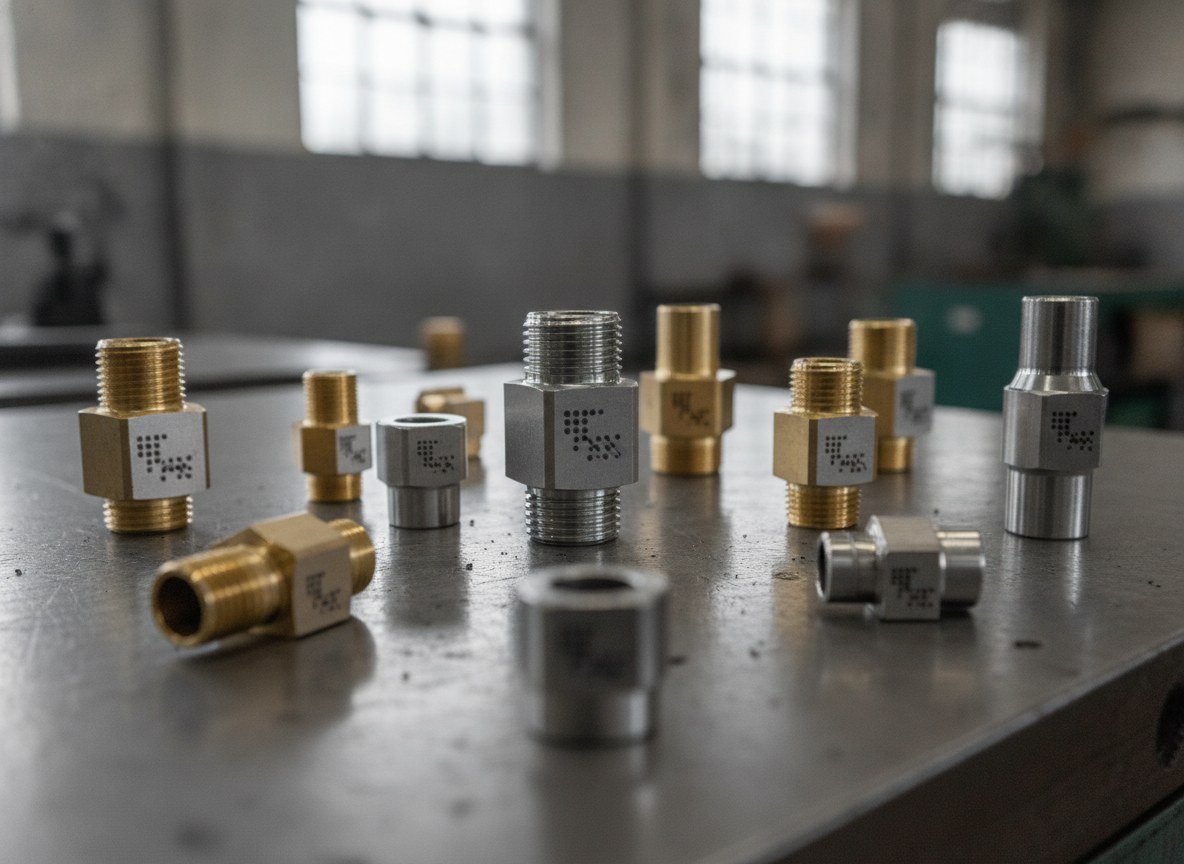
Direct fiber marking on assembled components is the right solution when the metal surface is accessible, suitable, and not critical for sealing, and when the data must stay tied to the part throughout its life. This is the typical case of rods, tubes, heads, blocks, and steel or brass fittings on which a serial number or a DataMatrix must survive oil, vibration, and service.
It isn’t, however, the route to force in three situations. When the usable surface is painted or coated in such a way that a legible marking would require breaking through the protection, a separate nameplate makes more sense. When the specification or industry standard requires a metal data plate with extensive information, that remains a requirement, not an option. And when the area to be marked can’t be reached on the assembly without a risk of contamination that can’t be managed, the correct choice is to pre-mark the components before assembly or, where necessary, to disassemble. Recognizing these cases is as much a part of the solution as knowing how to mark without disassembly.

Business Development Director | LASIT
Business Development Director at LASIT, Giandomenico Ievoli is responsible for the commercial direction and strategic development of the company. He leads business development activities at national and international level, contributing to the growth and expansion of LASIT in global markets.


