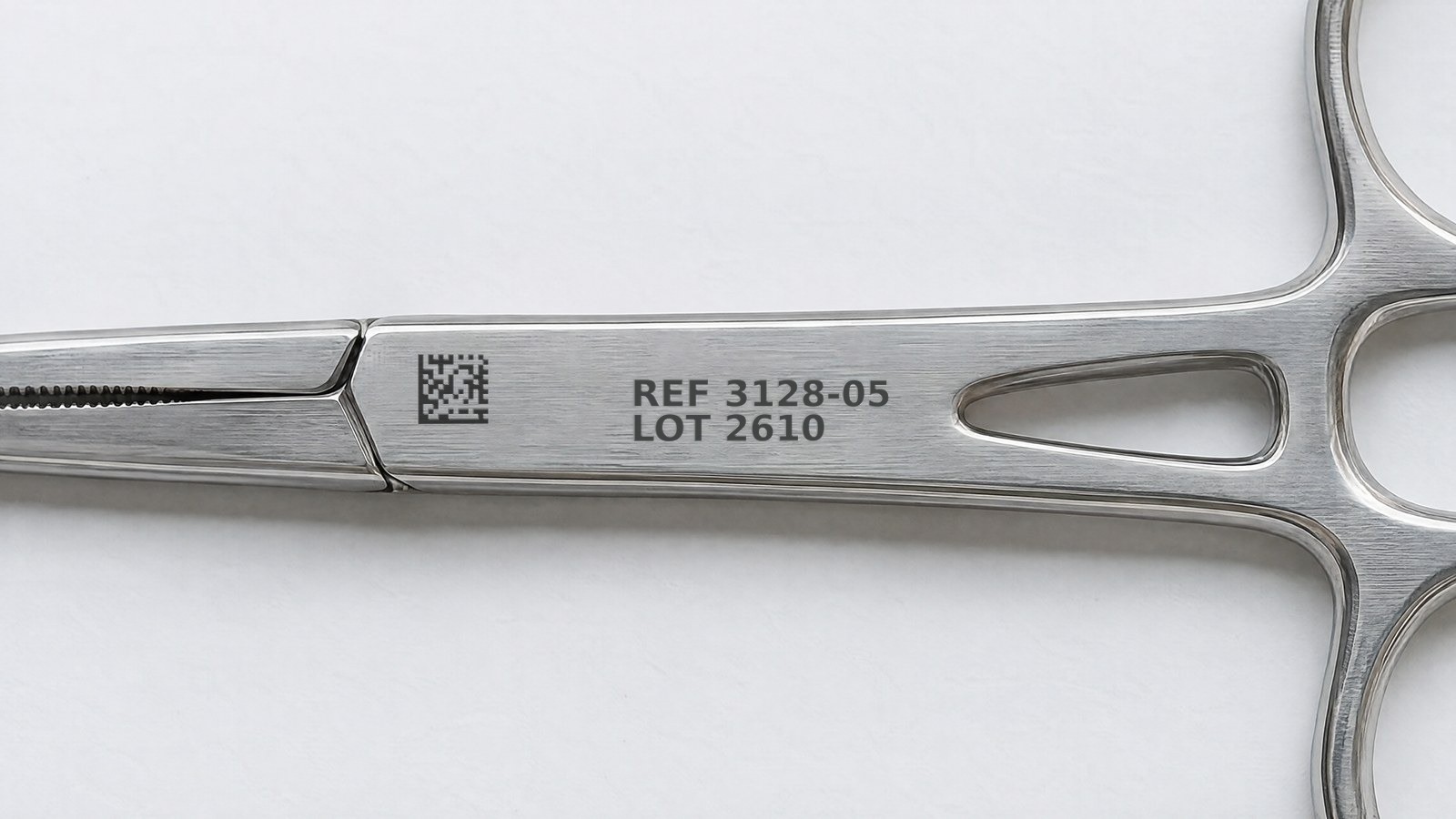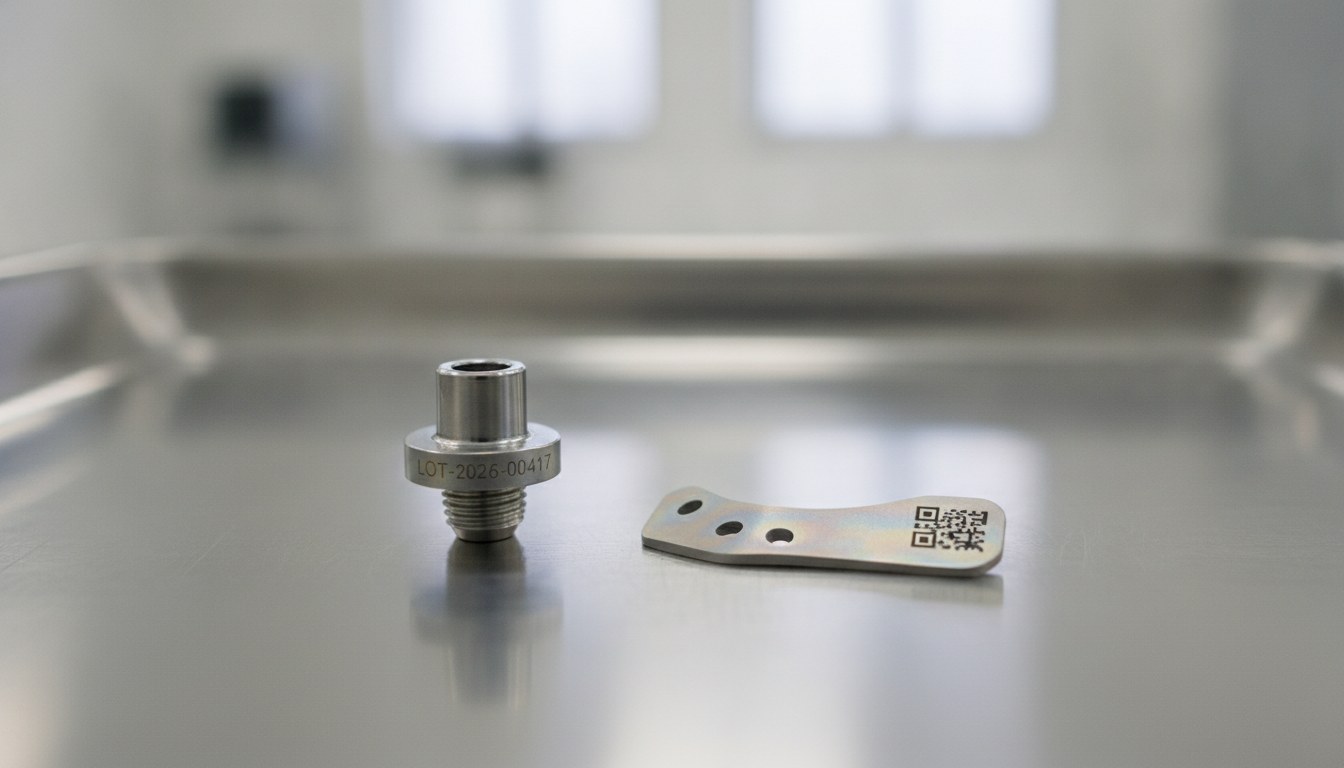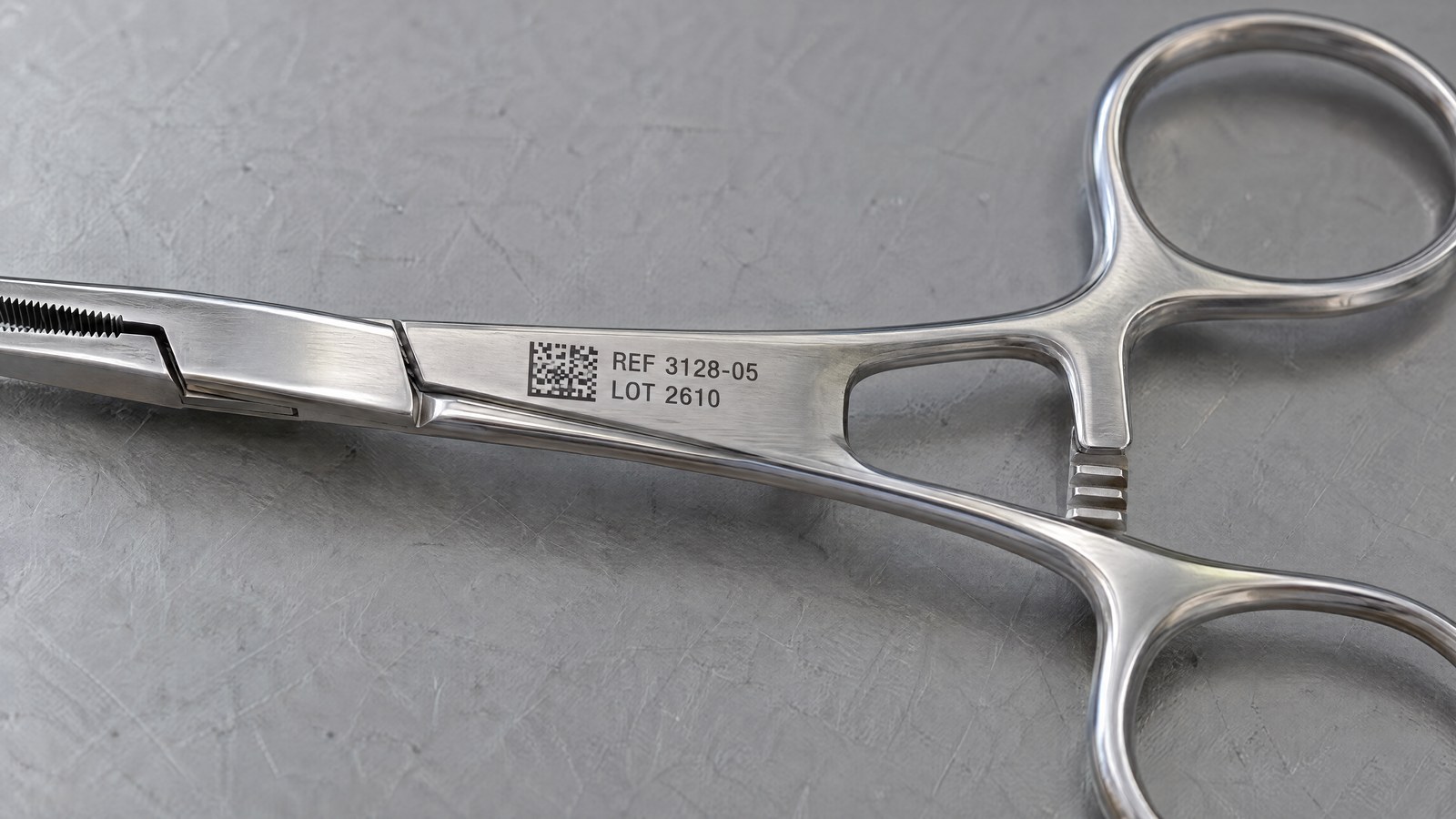
Manufacturers of reusable surgical instruments live with a constraint that allows no shortcuts: every forceps, needle holder, retractor, or clamp returns to the sterile processing department dozens, often hundreds of times over its service life. With each cycle the instrument passes through washing in an alkaline solution in the washer-disinfector, rinsing, and saturated steam in the autoclave. The code engraved on the handle must remain legible from the first of these cycles to the last, because instrument traceability is not a label that gets reapplied: it is a permanent piece of data tied to the part.
This is where a precise technical tension arises. To be permanent, the mark has to withstand abrasion, steam, and detergents; to be hygienic, the instrument’s surface cannot have cavities, grooves, or micro-fissures where organic residue and biofilm can lodge and escape reconditioning. A deep mark satisfies the first requirement and jeopardizes the second. It is the point where how you mark matters as much as what you mark.
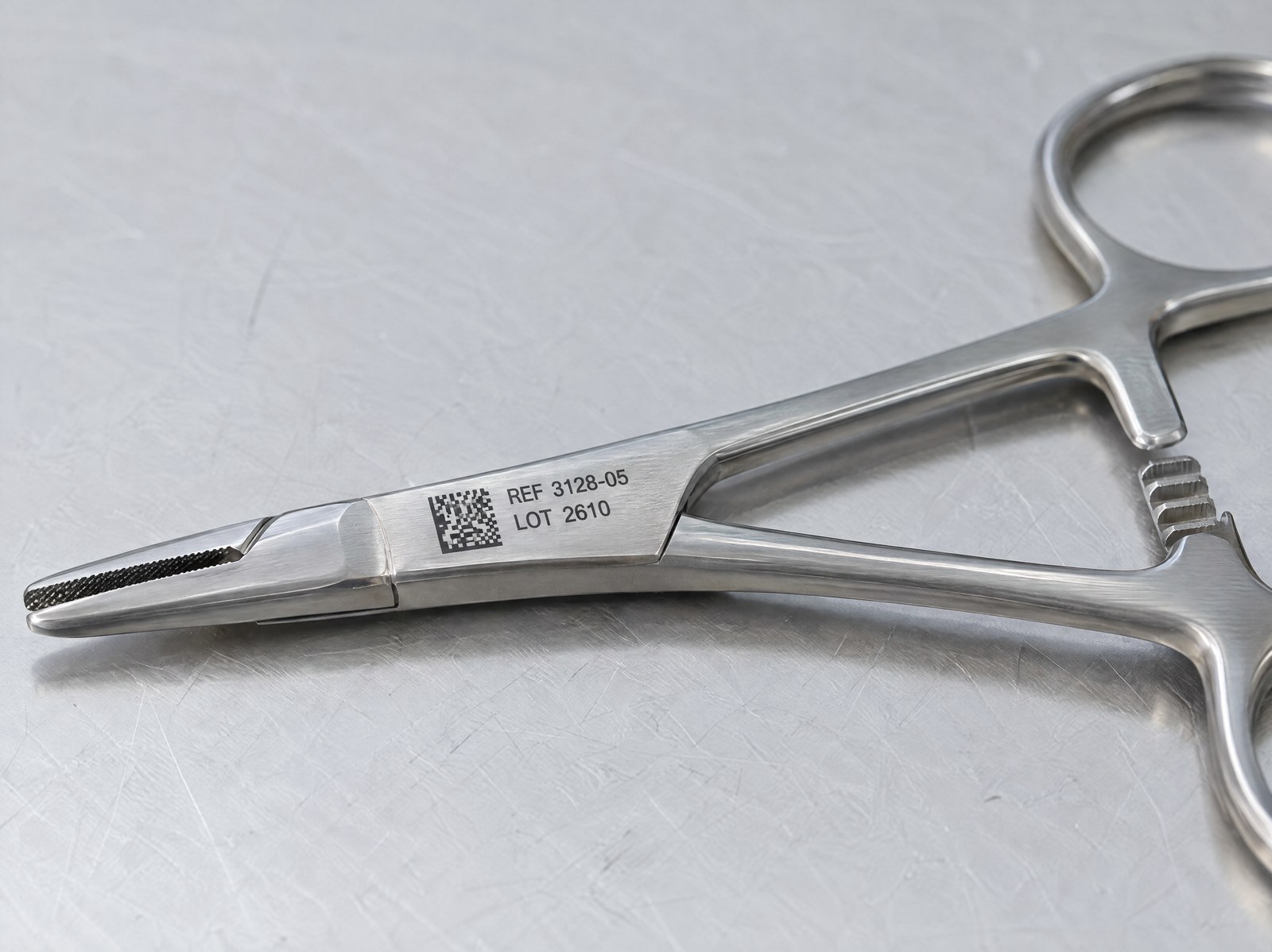
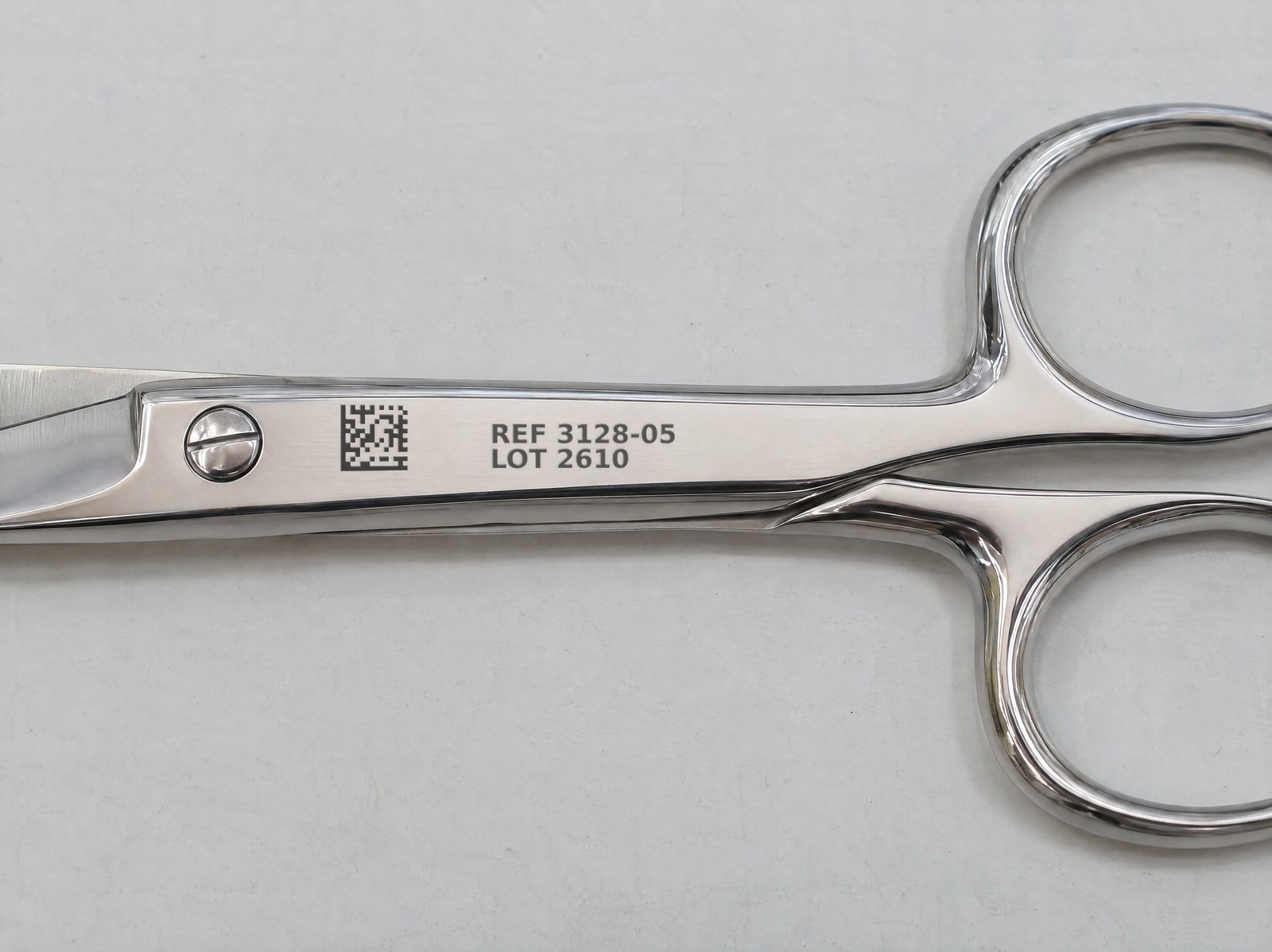
Laser annealing addresses exactly this tension: it produces a high-contrast code with no material removal, because the information resides in a layer of oxide grown within the surface and not in a groove carved on top of it.
Why a groove is a reconditioning problem, not just a cosmetic one
On reusable instruments, surface cleanability is a process requirement, not a cosmetic detail. Reconditioning must remove the organic load in a verifiable way: any geometry that traps residue — a groove, a raised edge, a micro-cavity — becomes a point where cleaning is harder to achieve and harder to demonstrate. On a device that will return to contact with the patient, a mark that carves into the surface introduces exactly this kind of retention.
Deep engraving and stamping solve permanence by creating a geometry: the mark exists because material has been removed or deformed. That same geometry, however, is a potential site of retention. The paradox is that the deeper the mark — and therefore the more “permanent” in a mechanical sense — the farther the surface moves from the smooth, continuous condition the sterile processing department must guarantee cycle after cycle.
Annealing: the code lives in the oxide, not in removed material
Annealing is a controlled oxidation process. The beam from a fiber source locally heats the stainless steel below the melting and ablation threshold: the heat grows a layer of oxide beneath the surface that, through optical interference, appears dark and high-contrast. No material is removed, no crater forms. The mark is chromatic, not geometric, and the surface stays substantially continuous and flush with the surrounding metal.
The consequence for the medical field is direct: a DataMatrix produced by annealing introduces no new cavities on the instrument’s surface. The code is legible thanks to the contrast between the oxidized area and the polished metal, not thanks to a relief the reader has to “feel.” The same controlled-oxidation logic governs the marking of titanium in implantable devices, where we explored controlled oxidation on titanium and UDI codes; on surgical stainless steel the principle is analogous, but calibrated to the life cycle of an instrument that is reconditioned repeatedly.
| Characteristic | Deep engraving | Annealing |
|---|---|---|
| Material removal | Yes | No |
| Groove or cavity on the surface | Present | Absent |
| Cleanability in the marked area | Reduced inside the mark | Continuous surface |
| Location of the information | Carved geometry | Oxide layer |
The quality of this layer depends on the parameters: the annealing process window must be calibrated so the oxide is stable, uniform, and free of excessive heat input, so the surface retains its corrosion resistance. It is a control that is defined on the real material and the real geometry of the instrument, because martensitic and austenitic steels respond to heat differently.
Saturated steam and alkaline detergents: what the mark faces
The environment the code must pass through is aggressive and repetitive. In the washer-disinfector the surface encounters alkaline detergents at elevated temperature; in the autoclave it encounters pressurized saturated steam. Each cycle is a small thermochemical treatment, and a reusable instrument accumulates many of them over its service life. A poorly controlled surface mark can lighten, shift in tone, or lose contrast precisely under this sequence.
The advantage of annealing is that the oxide is an integral part of the surface: it is grown from the substrate, not a deposit laid on top. A stable, cohesive oxide layer is the prerequisite for the code’s contrast to stay constant through the cycles, without the degradation typical of a mark that lives only on the very outermost skin of the surface. Verifying this behavior, however, is not taken for granted: it is measured, and that is what makes the data usable in the technical file.
Permanent DataMatrix legibility: from contrast to grading
Permanent legibility means an industrial reader decodes the code reliably for the entire life of the instrument, not just at the initial inspection. On a polished surgical surface this depends on two factors: the stable contrast between the oxidized area and the metal, and the clean geometry of the DataMatrix modules. Annealing works well on both, because it produces a dark, matte mark that does not rely on a relief to be read.
Code quality is measured through grading, the standard that can be applied in line to DataMatrix codes, distinct from verification proper, which requires controlled laboratory conditions. It is an important operational distinction: these are different levels of control with different purposes, as we explained when analyzing the difference between reading, grading, and verifying codes. Assigning a grade to the code right after marking, and then going back to evaluate it after the reconditioning cycles, turns “legibility” from a qualitative impression into a documentable value.
Documenting the code’s durability over time for the technical file
A code that is permanent on paper and a code whose permanence is demonstrated are two different things. The instrument’s technical file needs the second: a repeatable proof that the mark withstands the real reconditioning sequence the device will undergo. The path is experimental before it is documentary.
Document code durability for the dossierSample markingReconditioning cyclesCode gradingRecord in the dossierIn practice, you mark representative samples of the instrument, subject them to repeated cycles of alkaline washing and steam sterilization, and at defined intervals you re-read the codes, assigning a grade. Comparing the initial grading with the grading after the cycles shows whether and how much the contrast is maintained, and provides the data that goes into the file. It is the same rigor with which we tackle the root of nonconformities in UDI marking on metals: compliance is not asserted, it is measured on real samples. The LASIT laboratory is designed to build this evidence on the customer’s specific materials and cycles.
Who it is designed for (and who it is not)
Annealing is the go-to choice when the instrument is stainless steel, is reconditioned many times, and the surface must remain cleanable: reusable surgical instruments, forceps, needle holders, retractors, containers, and components where a groove would be a hygiene problem before it is a reading problem. In these cases a code in the oxide combines permanence and surface continuity better than any geometric mark.
It is not, however, the universal answer. Where the requirement is a declared mechanical depth, or where the material does not develop a stable oxide useful for contrast, engraving or marks with different sources make more sense; on some high-end polished surfaces the choice of a black mark from an ultrashort pulse may prevail, since its heat input is negligible. The rule, valid here as always, is to start from the real material and reconditioning cycle, not from the technology: it is the autoclave–detergent–reading sequence that tells you which mark will hold up for the entire life of the instrument.

Applications Manager | LASIT
Applications Manager at LASIT for over 20 years, Mario Palmieri oversees the management and development of the company’s laser laboratory. He is responsible for conducting sample tests for customers, supporting the automotive, medical, aerospace and electronics sectors in identifying the most suitable laser marking solution for their needs.