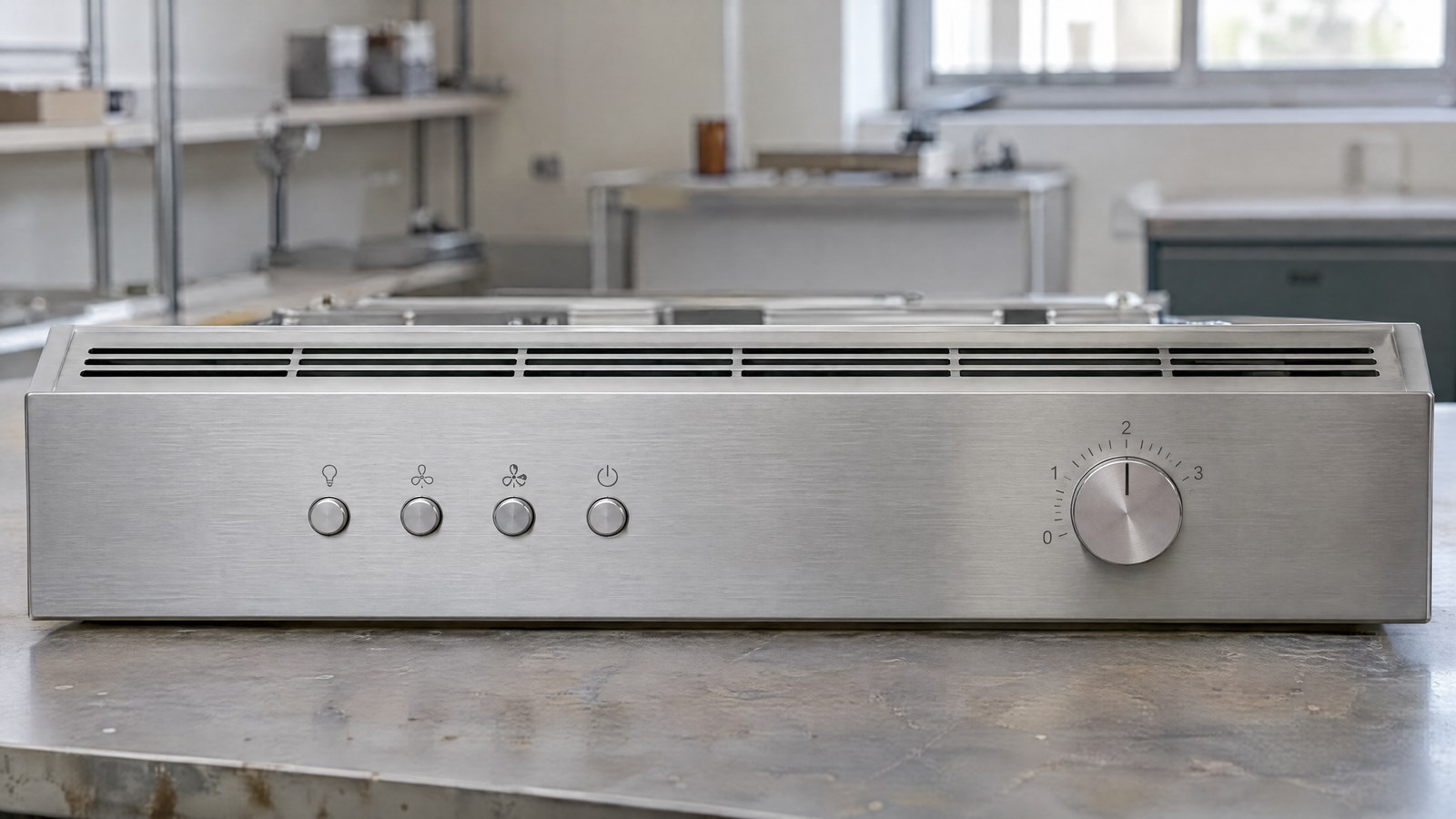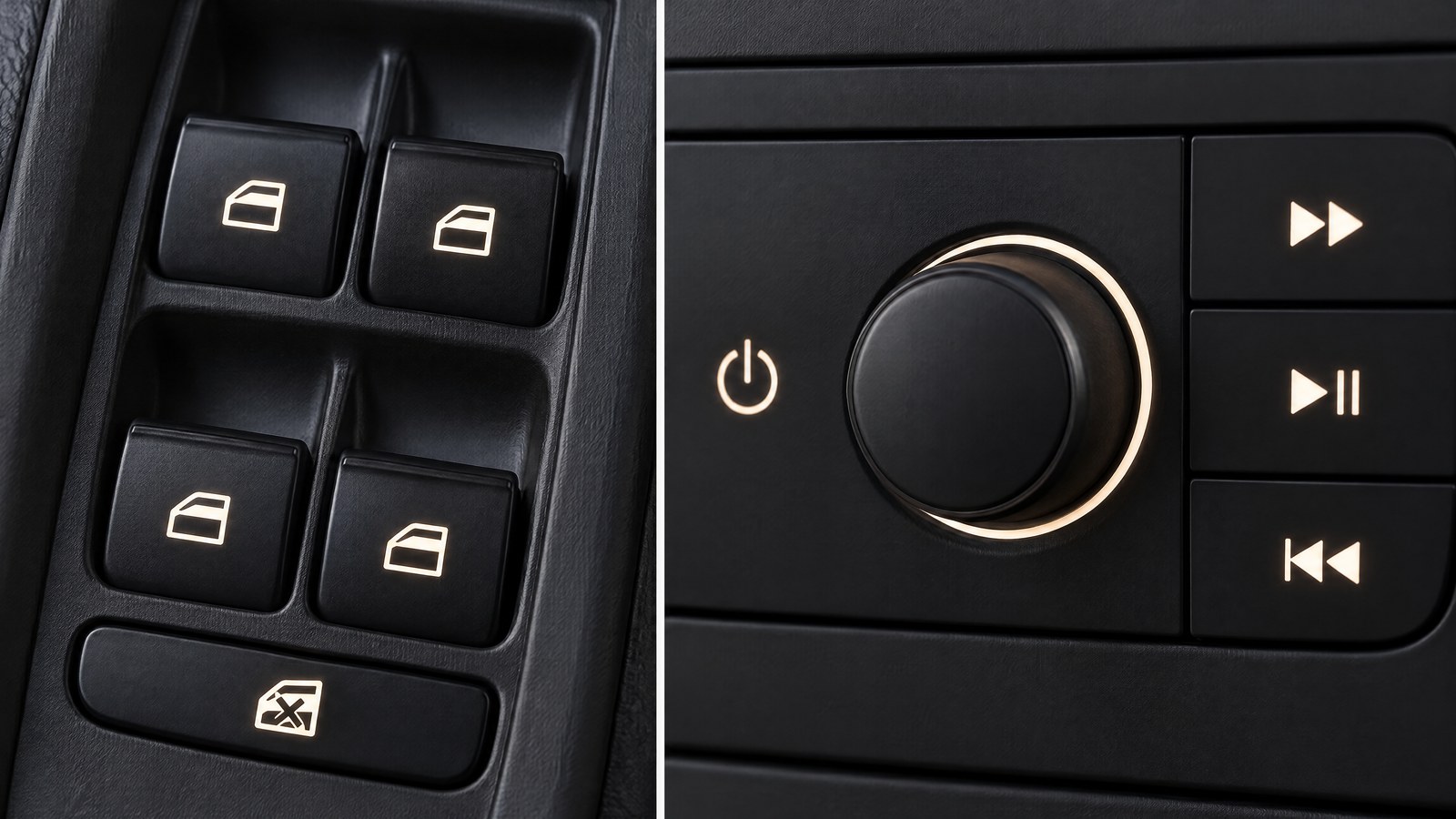
On the front panel of a washing machine, oven, or cooktop, the control symbols have to behave in two opposite ways on the very same part. By day, with the surface off, they are discreet marks on a plastic of uniform color; by night, or when the control is on, they light up from behind with a crisp, even glow. This is the day&night principle, and on an appliance it isn’t an aesthetic flourish: it’s how the user reads the panel and how the panel performs its function.
For anyone industrializing these front panels, the margin between “legible” and “reject” is thin and partly subjective. A symbol that at night shows halos, frayed edges, or a brightness different from the one next to it makes the panel inconsistent; a symbol that by day “bleeds through” breaks the neutral surface. And all of this has to stay identical from the first part to the last, across lots of tens of thousands.
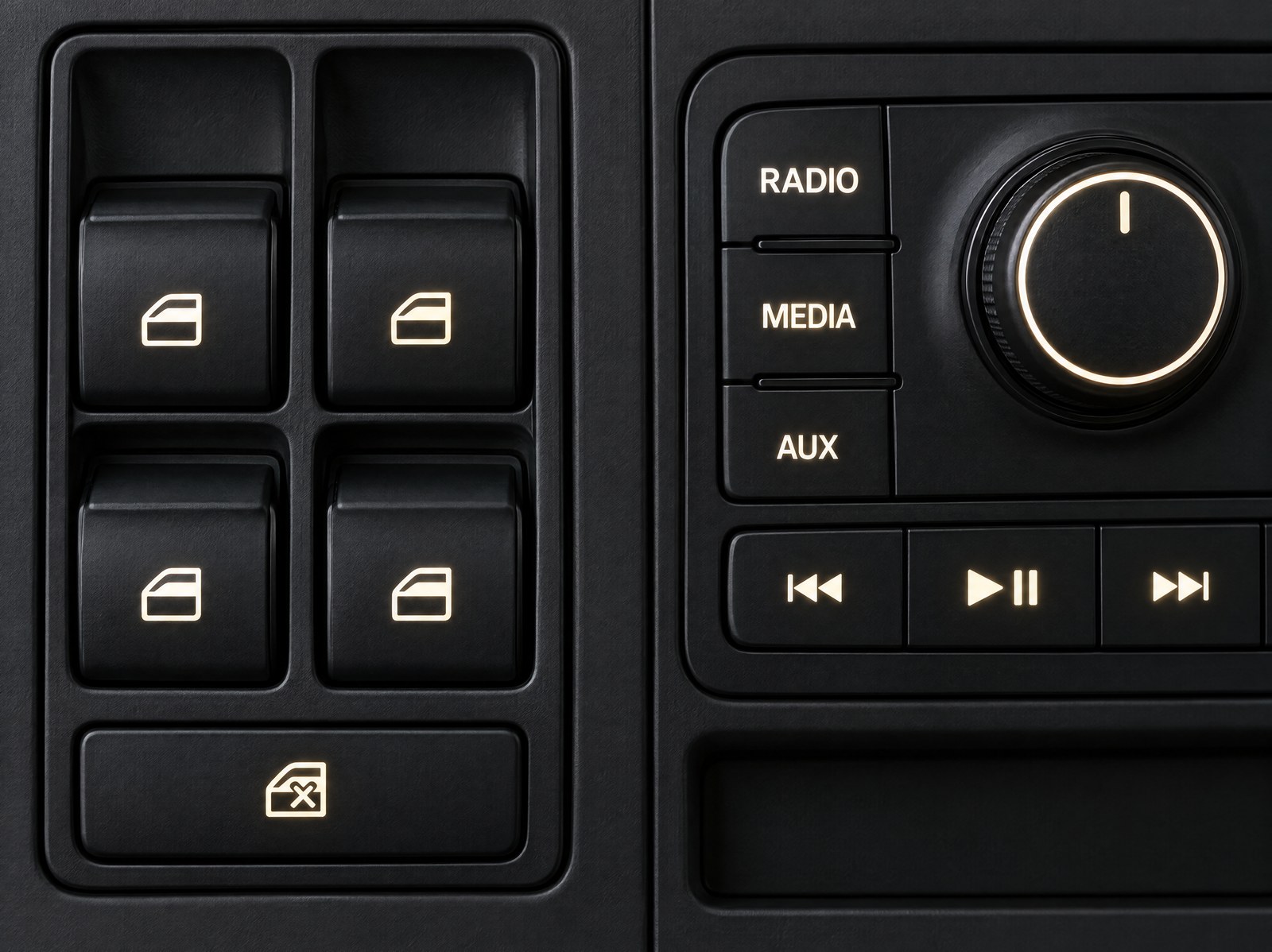
Day&night laser marking addresses exactly this problem: it doesn’t add a mark on top of the plastic, but selectively removes the layer that hides the light. The marking thus becomes the very function of the product.
When the marking is the function of the product
In most applications, marking tells the story of the part: a logo, a code, a batch number. With day&night, something different happens. The symbol doesn’t describe the panel, it makes it work: where the laser acts, the light passes through; where it doesn’t, the surface stays blind. The marking design and the optical behavior of the product coincide.
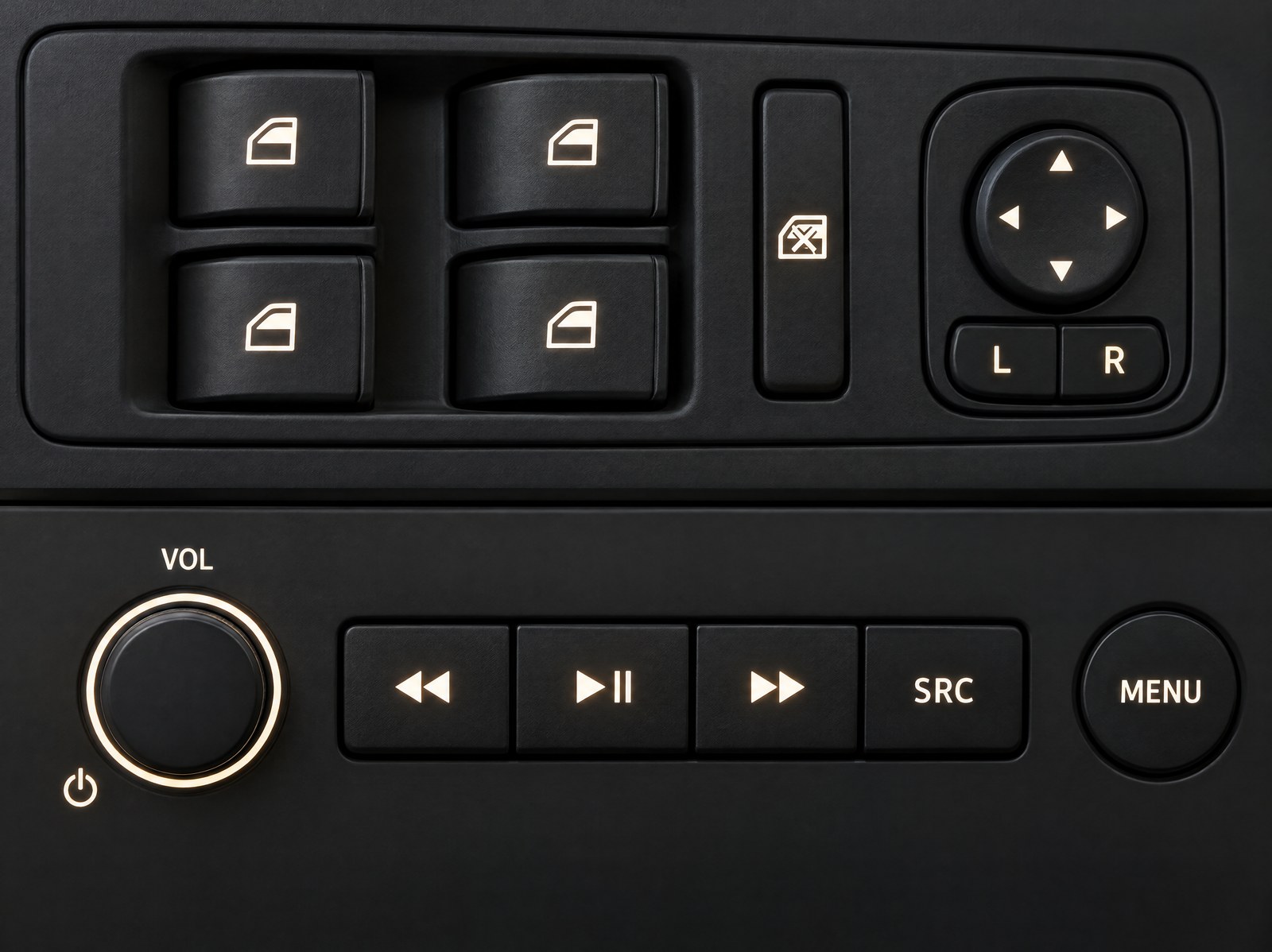
It’s the evolution of an approach LASIT has long described. Compared with what was covered in the article Day & Night Laser Marking, the point today is no longer just showing that the laser can “open up” a backlit symbol, but governing its optical quality layer by layer and its repeatability at industrial volumes. This is the leap that matters to anyone taking a front panel from prototyping to series production.
Selective ablation: removing the paint, not the base
The day&night part is built in layers. Underneath is a translucent substrate, typically an engineering polymer such as polycarbonate, able to let light through. On top are one or more opaque layers of paint, which by day make the surface uniform and opaque. The symbol is created by removing the paint exactly where the light needs to pass, without affecting the translucent base beneath.
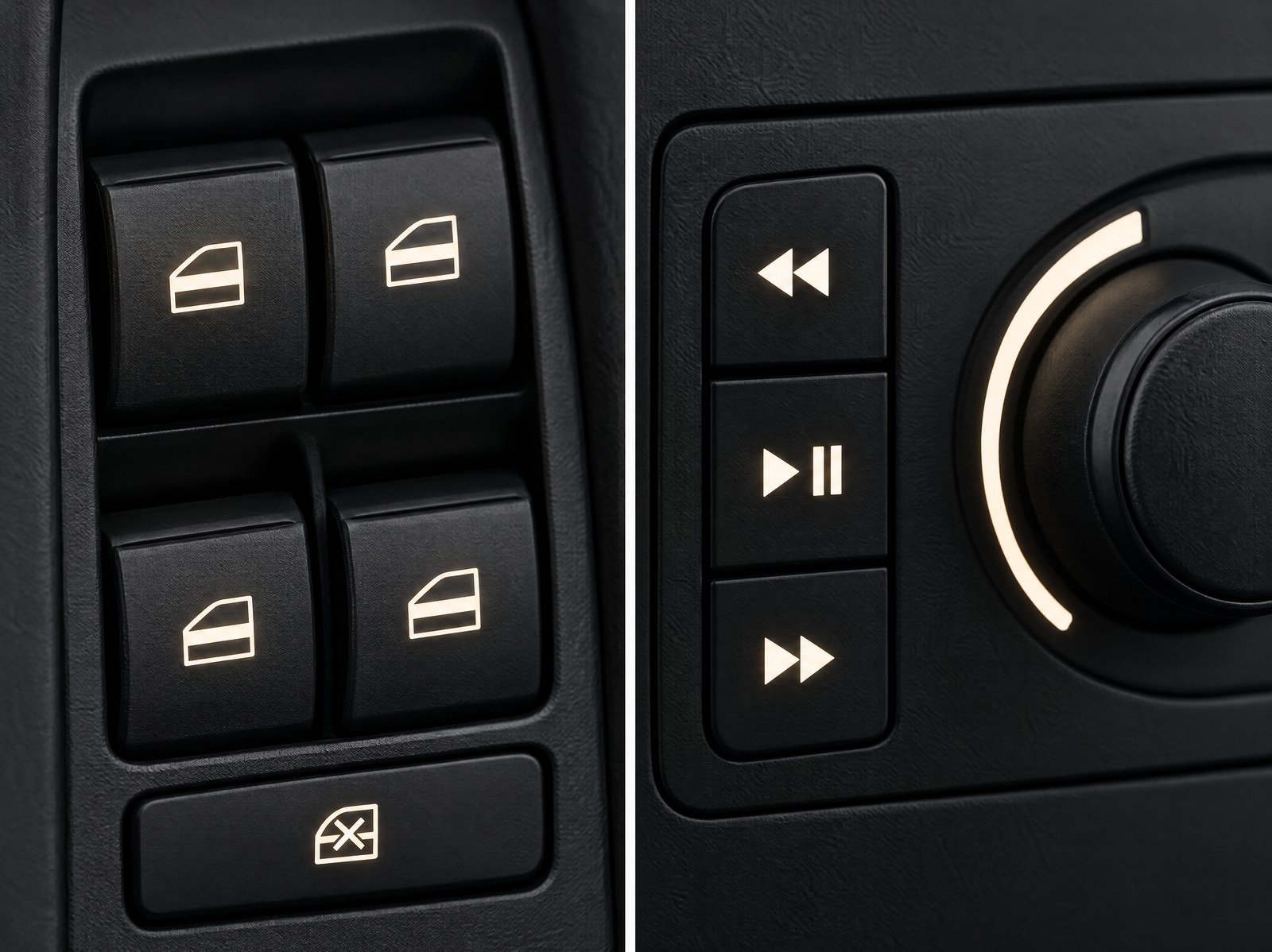
For this to work, you need a source that attacks the coating and not the substrate. The UV source at 355 nm is particularly well suited to painted plastics: the ultraviolet wavelength is absorbed intensely and superficially, and the process is predominantly photo-ablative, with limited heat input. Compared with fiber at 1064 nm or CO₂ at 10.6 µm, the interaction stays concentrated on the paint layer, a necessary condition for opening the symbol without deforming or clouding the polycarbonate that must stay clear.
How a day&night symbol is madeTranslucent baseOpaque layerSelective ablationUniform lightTransmittance control: even light by night, neutral by day
The perceived quality of day&night depends on how much paint is removed and how gradually. You don’t always go all the way down to the base: often the goal is to bring the residual thickness of the coating within a precise window, so that the light filters through diffuse and even rather than patchy. On multilayer stacks — for example an opaque base beneath a colored finish — removal has to be managed layer by layer, because each layer has a different optical behavior.
Governing transmittance means working on the energy deposited per unit of surface and on the number of passes, not on a single “threshold” shot. This is why day&night is laboratory work before it is line work: you define the ablation recipe that delivers the desired light yield, lock it into the FlyCAD management software, and repeat it part after part.
Paint removed Transmitted light Below threshold it stays blind; above, the light turns uniformCrisp edges: legibility in both conditions
A backlit symbol is only as legible as its outline. A frayed edge, with micro-burrs of paint or a wide transition zone, produces a halo of light at night and a dirty line by day. The advantage of the laser lies in the small spot size and the control of the affected zone: the symbol’s outline stays defined and repeatable, without the smearing typical of processes that remove material in a less selective way.
Edge sharpness is also what holds the dual day/night reading together. The same outline that defines the light at night defines the neutral mark on the painted surface by day: a single process must satisfy both conditions, which is why the acceptance criterion has to be verified in both, not just with the panel lit.
Aesthetic repeatability lot after lot and the reference sample
On an isolated panel, almost any process delivers a good result. The difference shows up across the lot: the industrial challenge of day&night is that the ten-thousandth symbol be indistinguishable from the first, and that the panel produced in March match the one from November. This depends on the stability of the source, on repeatable fixturing of the part, and on the ablation recipe staying locked and traced.
The reference isn’t a number, it’s an object: the approved reference sample, that is, the panel validated with the customer and the quality department that sets the light yield, the daytime tone of the mark, and the edge sharpness deemed compliant. Every lot is compared against that master, under controlled lighting conditions. It’s the kind of verification LASIT structures in its own quality test laboratory for home appliances, where the recipe is fine-tuned and validated on real samples before entering production.
Many front panels, moreover, aren’t flat: on curved or raised surfaces, correct focus across the whole area is itself a factor of uniformity. Systems with three-dimensional scanning such as POLARIS are designed to keep the symbol yield constant even on contoured front panels, where a focus that drifts at the edges would translate into a symbol lighter or less defined than at the center.
Soft-touch coatings: the constraint that dictates the parameters
Premium front panels often use soft-touch finishes, pleasant to the touch but delicate thermally: these are coatings that tolerate heat poorly and that, under excessive energy input, tend to yellow, become glossy, or shrink back along the edge of the symbol. It’s precisely these materials that dictate the process parameters.
The technical route is to keep the deposited heat low and controlled, exploiting the surface absorption of the ultraviolet and distributing the ablation across several light passes rather than concentrating it. It’s the same principle of selective coating removal that LASIT applies in other fields, such as decoating in automotive lighting: removing the intended layer while leaving intact what lies beneath. The practical rule is that the panel finish doesn’t adapt to the process, but the process is tailored to the finish.
Who it’s designed for (and who it isn’t)
Day&night laser marking is the natural solution for anyone producing front panels and control panels for appliances in painted plastic, with backlit symbols that must be legible both by day and by night, uniform and repeatable across large series. It is all the more suitable the more aesthetic quality is a criterion of quality rather than a detail, and the larger the lots: that’s where process repeatability and comparison with the approved sample make the difference over less controllable methods.
It is not, however, the right answer when the symbol doesn’t need to backlight but only to appear as a stable mark on non-layered plastic, or when the need is a functional traceability code: in those cases more direct marking solutions apply. And it remains a process that requires a preliminary study of the paint-substrate stack: without first defining the recipe and the reference sample, the yield can’t be governed. For a broader picture of the configurations dedicated to the sector, LASIT describes its own approach to custom laser systems for home appliances.

Applications Manager | LASIT
Applications Manager at LASIT for over 20 years, Mario Palmieri oversees the management and development of the company’s laser laboratory. He is responsible for conducting sample tests for customers, supporting the automotive, medical, aerospace and electronics sectors in identifying the most suitable laser marking solution for their needs.