
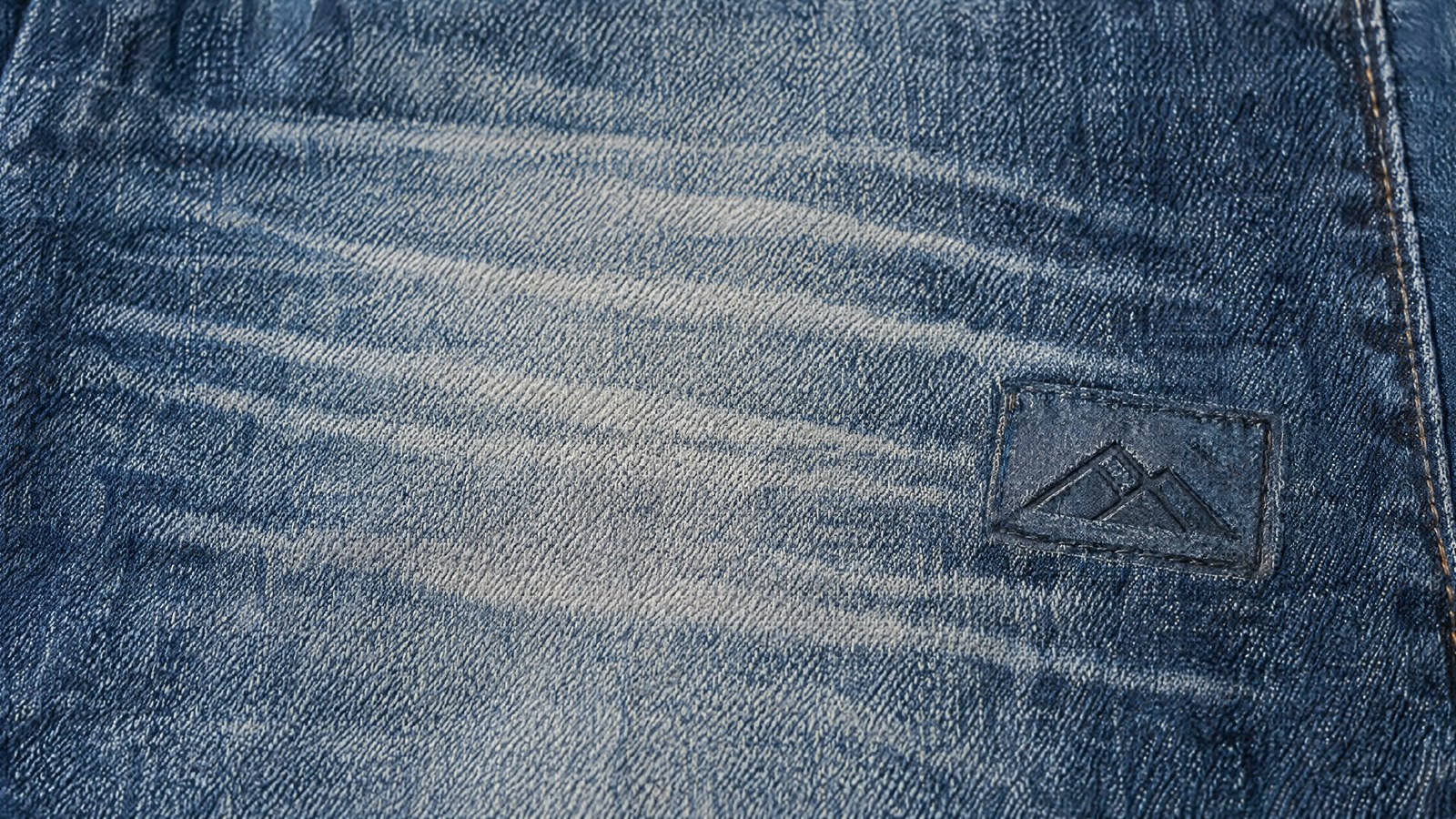
Anyone who manages finishing in textiles and leather goods knows how much weight the washing department carries: bleaching denim means baths of permanganate, hypochlorite and pumice, manual sandblasting and rinse cycles that consume water and generate effluent that has to be treated. On leather, pattern and localized color often come from mordanting, hot stamping and chemical treatments. These processes work, but they are variable, slow to retool and costly in environmental terms.
The laser addresses exactly this point. It is not the alternative to a print applied onto the fabric: it is the alternative to the chemical-water process that lightens, etches and shapes the material. The beam acts directly on the surface — it breaks down the dye, ablates the outermost layer, cuts the profile — using optical energy instead of water and reagents.
For a production or quality manager this means three things at once: a result that repeats identically batch after batch, a cycle that retools by changing a file instead of a bath, and a dry process that eliminates effluent and scrap. It is worth seeing where it really works — and where it does not.
The laser replaces the chemical bath, not the print
The distinction is fundamental. A print deposits pigment on top of the fabric; the laser adds nothing, it modifies the material that is already there. On denim it removes the surface dye, revealing the lighter cotton underneath; on leather it ablates a thin layer of finish or grain; on acetate it melts and separates the edge along a clean profile. It is the same principle, applied with different energies: unlike when you replace an inkjet print, here you are not laying down a mark but transforming the surface.
| Process aspect | Chemical-water process | Laser process |
|---|---|---|
| Water consumption | High, between baths and rinses | None |
| Chemical agents | Oxidizers and mordants | No reagents |
| Material scrap | Dedicated dies and offcuts | File-based layout, optimized nesting |
| Tone repeatability | Tied to concentration and bath time | Defined by digital parameters |
| Residue management | Liquid effluent to be treated | Air extraction and filtration |
The most immediate practical advantage is that the entire design lives in a vector file. Changing the effect, position or intensity does not require redoing a bath or a die: you modify the path and relaunch the cycle, with recorded, reproducible parameters.
Bleaching denim with no water or oxidizers
Denim owes its color to indigo, a dye that fixes to the outer part of the cotton fiber while leaving its core light. It is precisely this structure that makes it ideal for the laser: a CO₂ source at 10.6 µm, well absorbed by natural fibers, breaks down the indigo on the surface and brings out the lighter tone underneath, without affecting the weave.
By adjusting the beam energy you obtain a graduated lightening: from whiskers and localized abrasions to extended designs and patterns, all in a single dry pass. The degree of lightening is a direct function of the energy deposited, and therefore continuously controllable.
Beam energy Lightening level Tone is set by parameters, not the bath.Compared with the traditional cycle, permanganate, hypochlorite and pumice disappear, and with them the baths and rinses: it is a water-free finishing, consistent with the process sustainability goals the fashion industry is setting for itself.
Etching on leather and split: a controlled mark
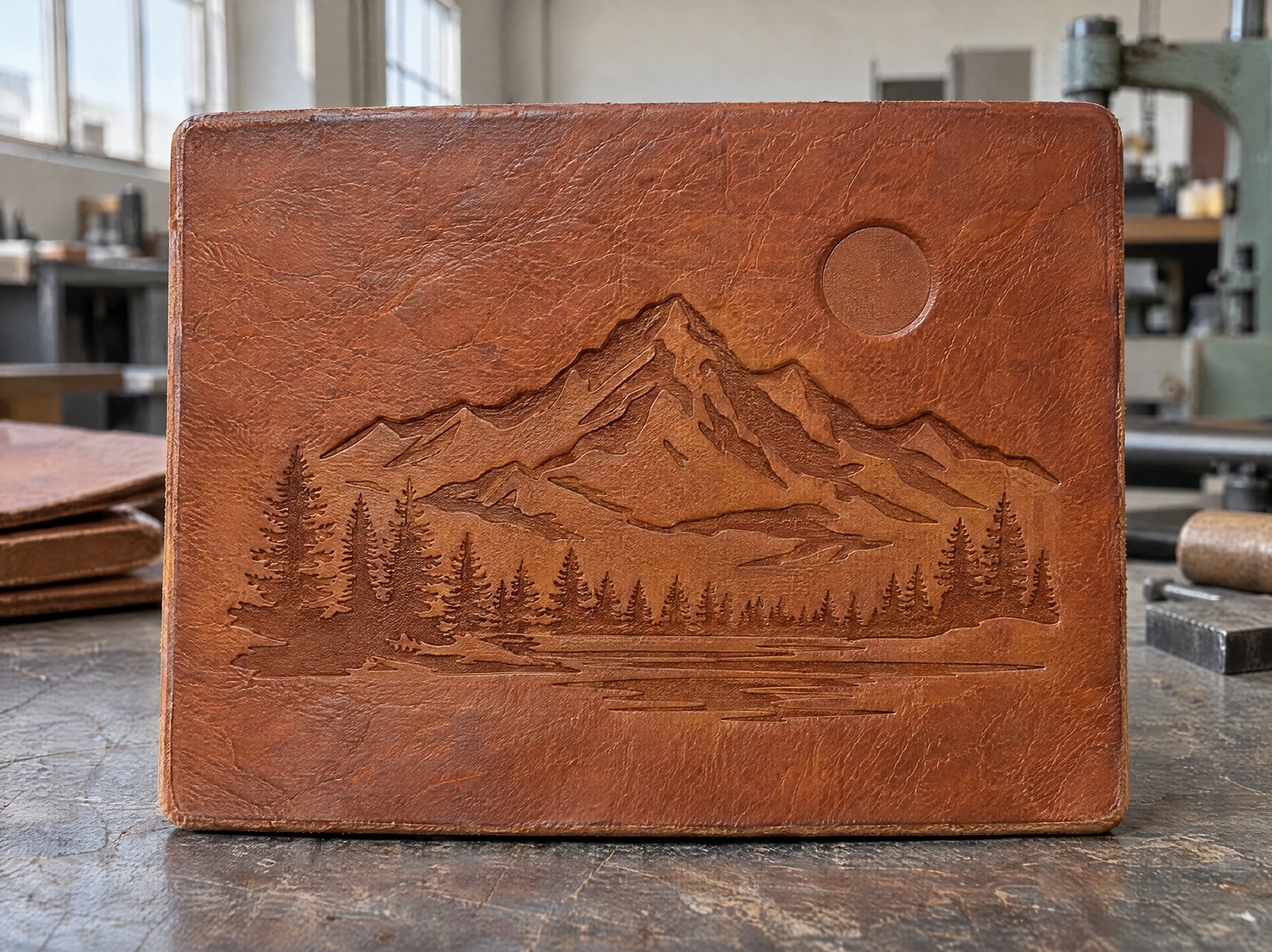
On leather the laser works by ablation: it selectively removes the most superficial layer and creates a contrast that depends on the material and the parameters, not on an ink. On full-grain leather, on split and on finished hides you obtain logos, monograms, textures and decorations with consistent depth and sharpness.
The result requires no mordanting or hot stamping with dedicated dies. The design is digital, and therefore customizable piece by piece — useful for capsules, numbering and personalization — while keeping the same mark across the whole series.
Cutting, perforating and working acetate
The same beam that lightens and etches can cut and perforate. On technical fabrics and synthetics, laser cutting produces a clean and — on thermoplastic materials — sealed edge, which limits fraying with no additional finishing. Perforation patterns, often impractical with a mechanical die, become simple vector paths.
Cellulose acetate, widely used in accessories and eyewear, lends itself well to controlled cutting and etching: the beam works the profile and the details with clean edges. Because the layout is digital, changing model means loading a different file, with no new dies to set up and with nesting that reduces material scrap.
Fumes, odors and dedicated extraction
Dry-working organic materials such as cotton, leather and acetate generates fumes and odors: this is the point to pay the most attention to in a laser finishing system. It is not a detail to overlook, but a design requirement. Stable processing requires extraction systems and filtration sized for the material and the production volume, capturing residues at the point of work and keeping the optics clean.
The advantage is that here we are talking about air management, not liquid effluent: residues are captured and filtered locally. This is an aspect that deserves a dedicated look at extraction systems in laser marking machines, because both the quality of the result and the conditions of the department depend on it.
Tone repeatability, batch after batch
The historical limitation of wet processes is variability: the outcome of a bath depends on concentration, temperature and immersion time, and two batches treated at different times are rarely identical. The laser reverses this logic. Tone, depth and design are defined by numerical parameters saved in the processing program, and therefore independent of the operator and of the aging of a bath.
Across broad product families this translates into aesthetic consistency between garments, between sizes and between reorders months apart — an aspect that, in fashion, counts as much as the quality of the single piece. Visual verification remains part of the cycle, but it starts from a stable, documented baseline.
Who it is designed for (and who it is not)
Laser finishing is at its best where the material is homogeneous and predictable: denim, finished and coated hides, technical synthetics, acetate. In these cases the tone is controllable and repeatable, the cycle is dry and the model change is immediate.
It should instead be approached with caution on very natural and non-homogeneous hides — vegetable-tanned leathers, aniline full-grain with veining and variable absorption: here the same energy can produce different tones from area to area, and color consistency is not guaranteed. On these materials the laser remains useful for etching and decoration, but the promise of uniform tone has to be verified first on real samples.
In short: if your finishing today depends on chemical baths, water and sandblasting, and you need a repeatable, dry result on denim, finished leather or acetate, the laser addresses exactly those steps. If you work natural, living hides, it should be tested in the field before industrializing it — and that is precisely what a test on samples lets you establish.

Public Relations Manager | LASIT
Public Relations Manager at LASIT since 2019, Claudia Neri is responsible for managing the Marketing and Communications department. She handles the company’s communication strategy, coordinating public relations, brand promotion and institutional communication activities for the Italian and international market.


