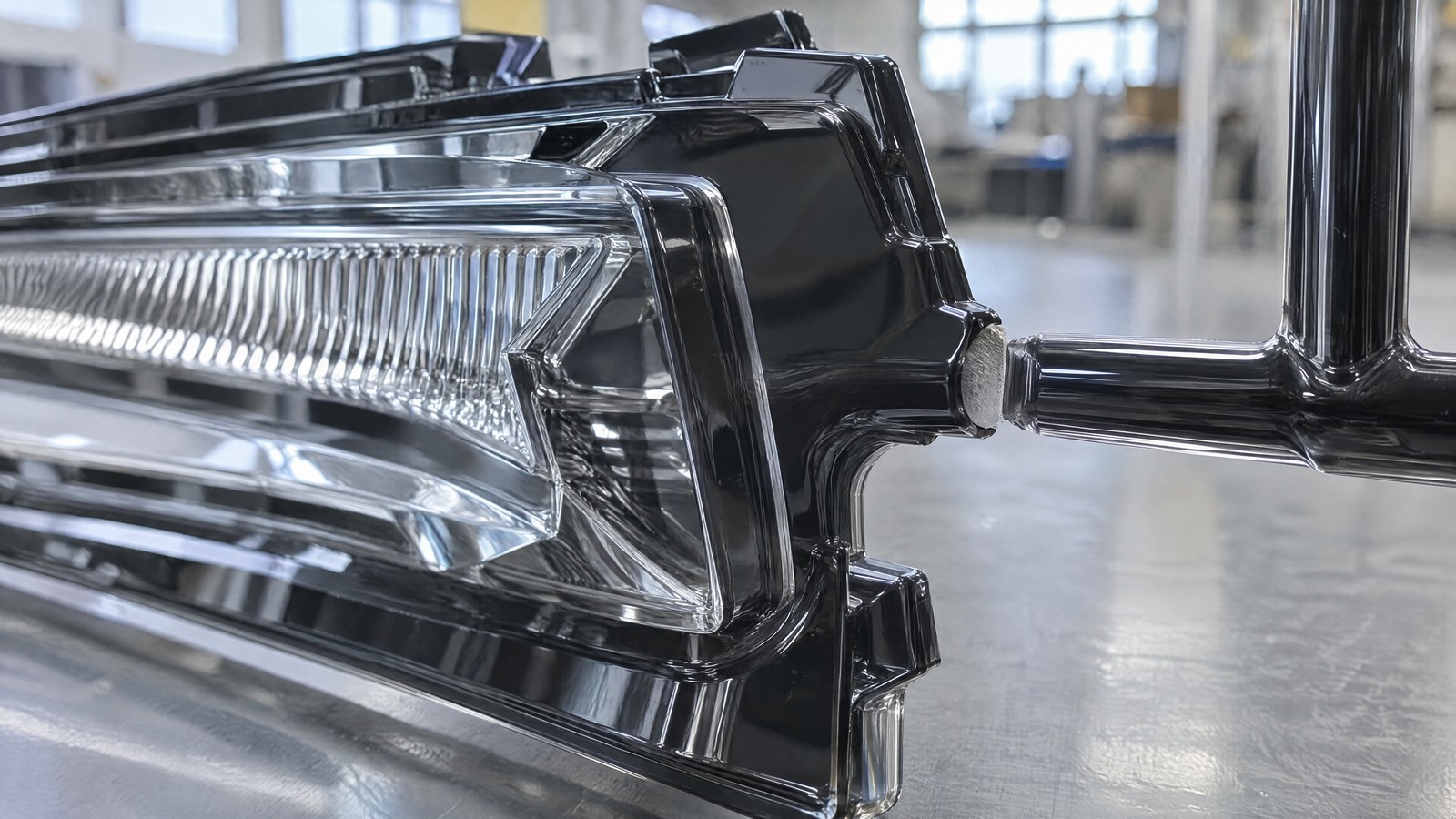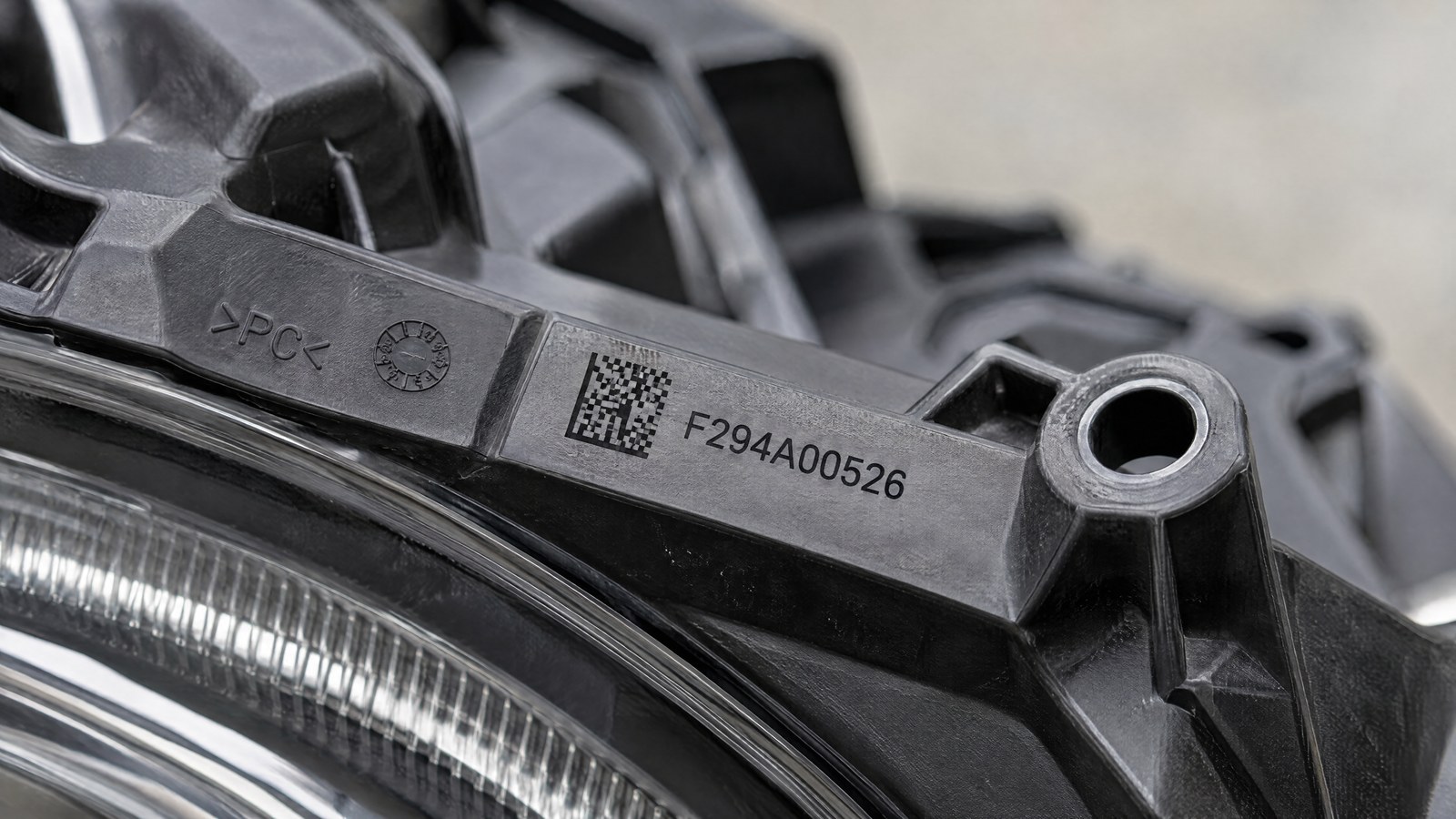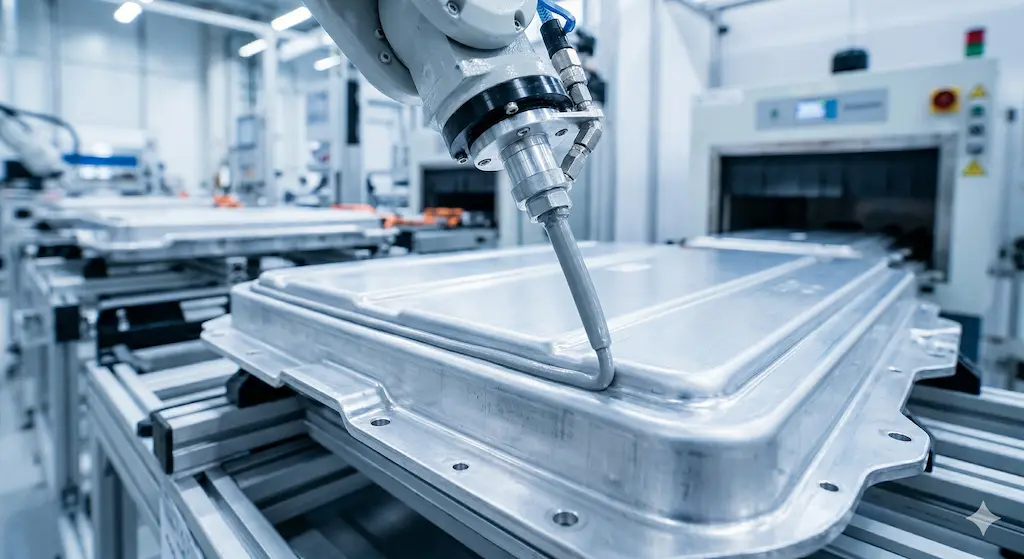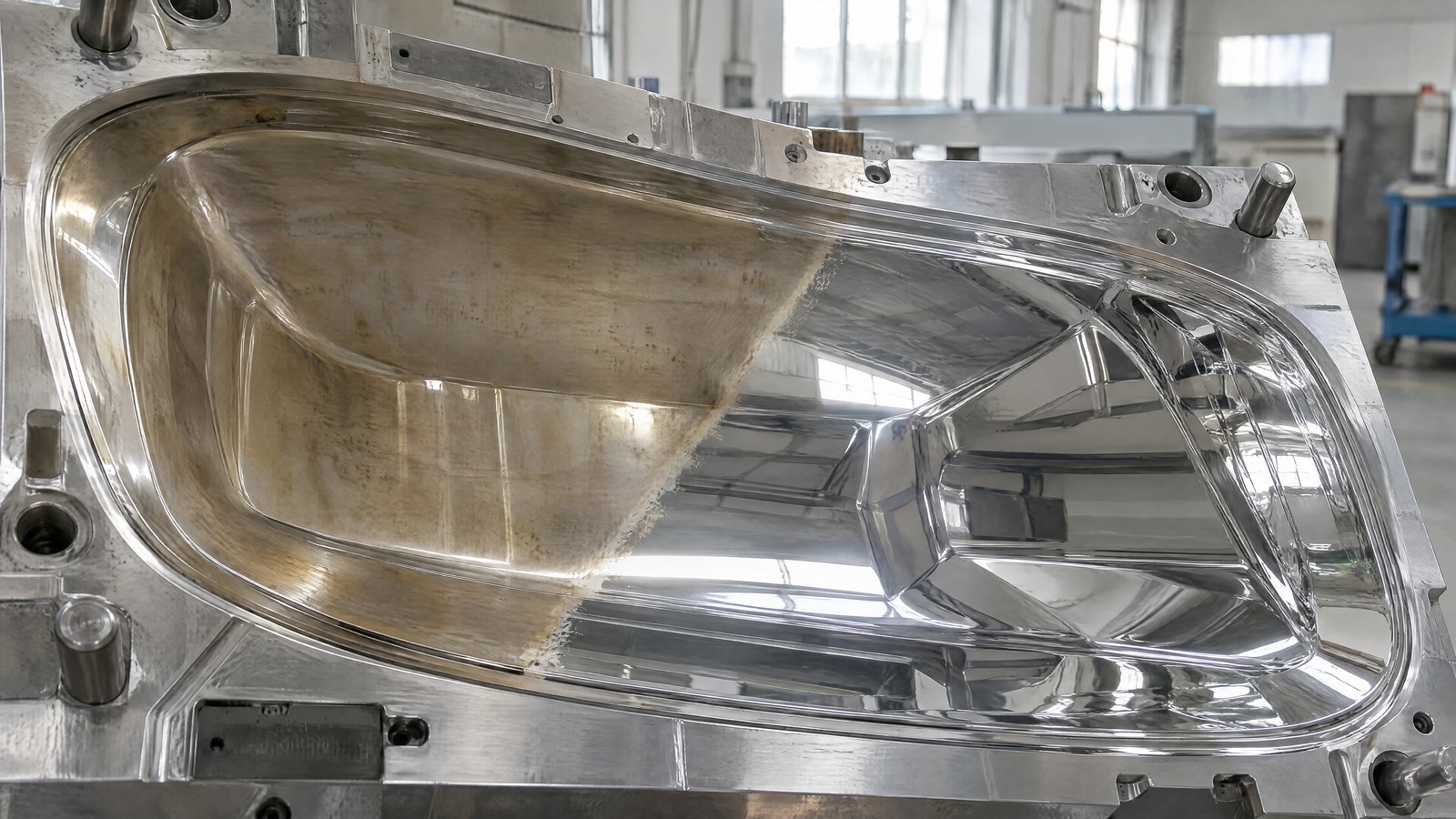
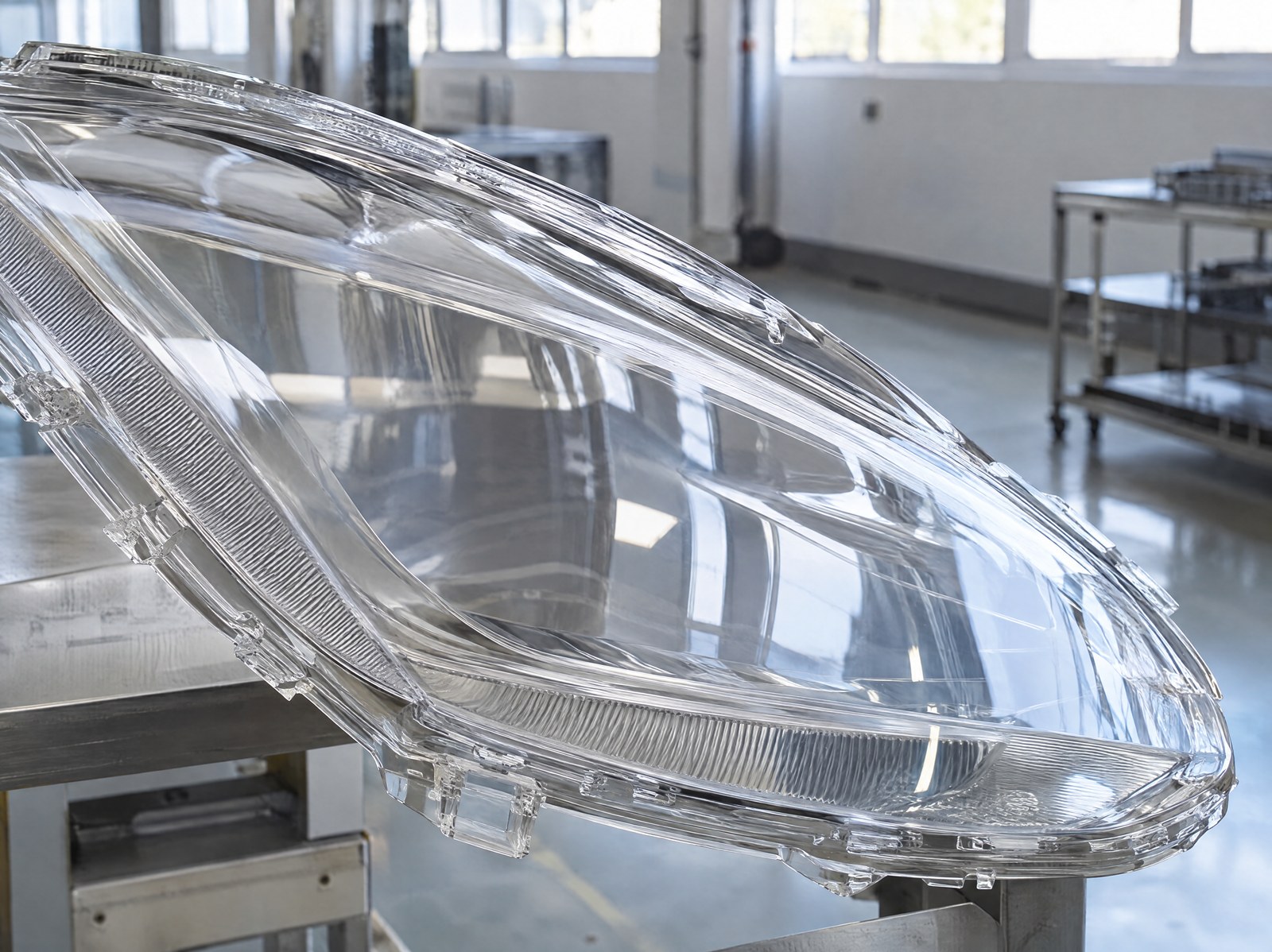
Companies that produce lenses, reflectors, and optical assemblies for automotive lighting work with molds whose cavity is no ordinary surface: it’s a piece of optics in every sense. The headlight beam is born from the geometry and finish of that cavity, and any defect that forms on the mold steel transfers in positive onto the molded part. That’s why a thin film of deposit on the mold becomes, on the finished lens, a haze, a cloudiness, or a distortion of the light beam.
The problem is that optical molds build up deposits with annoying regularity. Molding polycarbonate and PMMA releases degradation products and volatile substances that condense on the cold walls of the cavity; to these are added release-agent residues and the byproducts of additives and stabilizers. Shot after shot, a thin film builds up that first dulls the brilliance of the part and then sends it out of spec.
The temptation is to clean the mold the way it has always been done: solvents, cloths, abrasive pastes, hand polishing. But on a mirror-polished surface every mechanical action is a risk: a single abrasive residue or micro-scratch is enough to compromise the very optical finish that gives the mold its value. Laser cleaning addresses exactly this dilemma, because it removes the deposit without contact and without abrasives, acting selectively on the dirt and not on the metal underneath.
Why deposits form on optical molds
In molding transparent parts, mold contamination is a process phenomenon, not an accident. Optically transparent polymers are processed at high temperatures and, as they degrade, release volatile fractions that migrate toward the colder zones of the cavity and settle there. The foggy effect in automotive lighting comes from the same family of residues, except here what condenses is not the part but the wall that forms it.
The deposit is typically a thin, adherent, uneven organic film. It isn’t always visible to the eye on the polished cavity, but it shows up immediately on the molded part as a loss of transparency, halos, or reduced optical contrast. The moment the lens is no longer optically clean, the mold has to be stopped and treated: and this is where the cleaning method becomes a critical choice.
Why traditional cleaning puts the mirror polish at risk
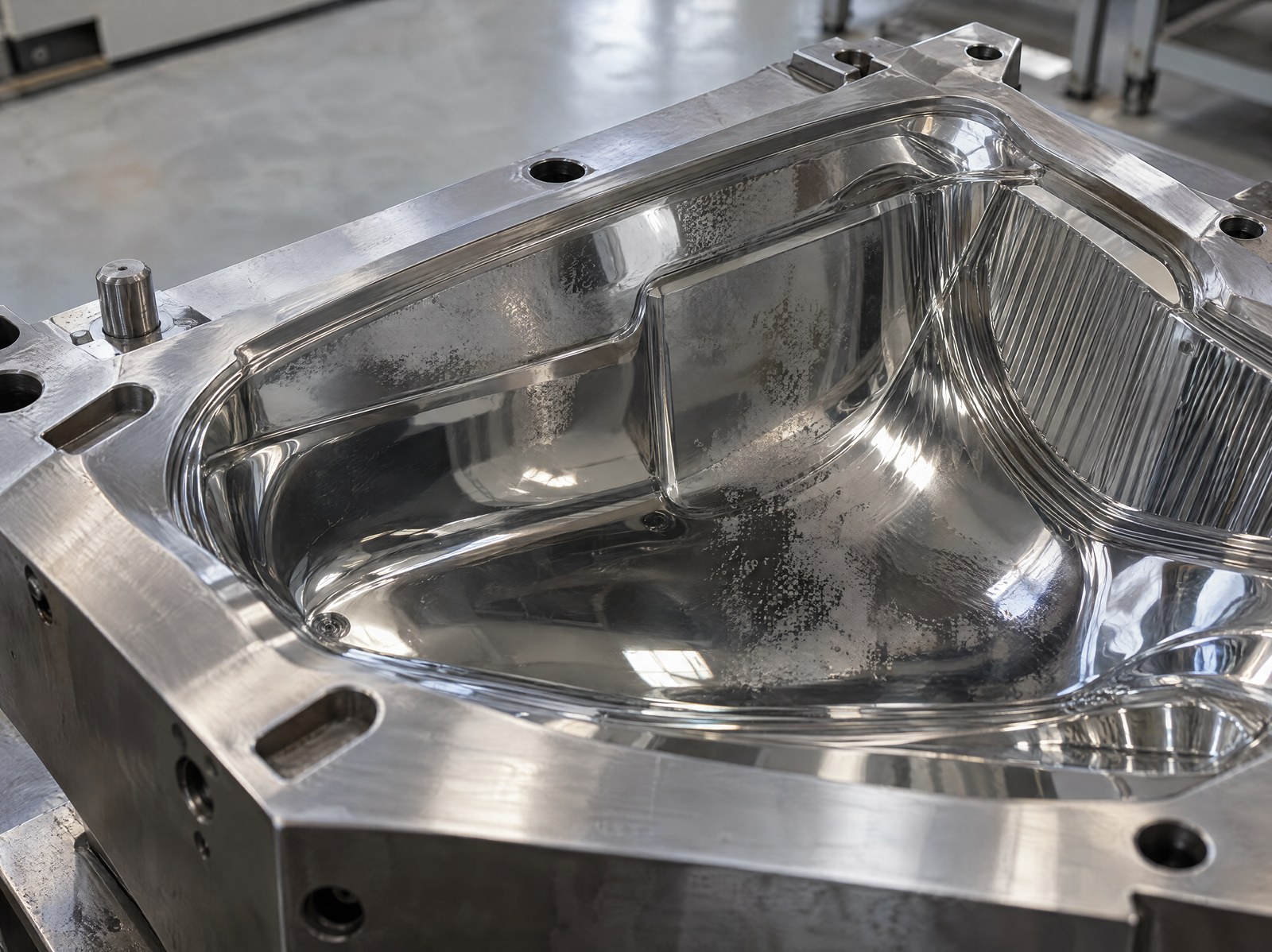
The mirror finish of an optical mold is the result of progressive polishing—long and costly, often carried down to the micron level. It’s a surface that is fragile precisely in its perfection: anything that drags across it leaves a mark. Abrasive pastes remove a fraction of the metal along with the dirt and tend to round off the sharp edges of the optical geometry; aggressive solvents can leave halos or attack any coatings; hand cleaning depends on the operator’s touch and is not repeatable.
Compared with blasting methods the issue is even clearer: as already discussed regarding laser cleaning versus sandblasting, any abrasive projected against a polished surface alters its micro-roughness. On an optical mold this means turning a mirror wall into a satin wall—in other words, throwing away the polishing work. Traditional cleaning, in short, solves the deposit problem while often creating a worse problem on the finish.
How laser cleaning removes deposits without contact
Laser cleaning exploits a physical difference between the deposit and the mold metal. The organic film absorbs the radiation of the pulsed fiber laser far more than the polished steel beneath it, and for every material there is an ablation threshold, a value of energy above which the material is removed. By setting the process so that the energy exceeds the deposit’s threshold but stays below the steel’s, the dirt is removed while leaving the surface intact.
Pulse energy Material removed Deposit has lower threshold than polished steelThe short pulse concentrates the energy in a very brief span of time: the deposit vaporizes or detaches through micro-expansion, while the heat that reaches the metal stays contained. It’s the same principle behind surface decontamination with cleaning lasers: a selective process, controllable at the parameter level and repeatable, because it doesn’t depend on the pressure of a hand but on set, recallable values. On top of that, it’s a dry process that introduces no abrasive consumables and no solvents to dispose of.
Mirror or textured mold: the finish changes the process
Not all optical molds have the same finish, and that matters. On mirror-polished cavities for transparent lenses the goal is to remove the film without touching the brilliance: the process window must be tuned tight, favoring gentleness over speed. On textured or microstructured surfaces, typical of certain reflectors, the deposit nests inside the texture and the cleaning has to reach it without flattening the relief that produces the intended optical effect.
In both cases the premise is the same: before treating a mold in production, the process is qualified on a sample or a test area, verifying under the microscope that the original finish is preserved. The laser’s selectivity makes it possible to adapt the parameters to the finish, but precisely because every surface has its own threshold, the cycle must be defined case by case and not transferred blindly from one mold to another.
What to consider first: material, coatings, downtime, and safety
Before bringing laser cleaning to an optical mold, a few practical considerations apply. The first is the material and any coating of the cavity: polished tool steels, surface treatments, or functional deposits react differently, and the process must be qualified on the actual material, not on an equivalent. The second is the geometry: deep cavities, undercuts, and steep walls call for studying beam accessibility, because cleaning is effective where the laser strikes the surface perpendicularly.
| Method | Contact with the surface | Risk to the mirror finish | Selectivity on the deposit |
|---|---|---|---|
| Laser cleaning | None | Low | High |
| Abrasive / sandblasting | Yes | High | Low |
| Pastes and hand polishing | Yes | Medium-high | Medium |
| Solvents | Yes | Variable | Medium |
Then there’s the matter of downtime. Laser cleaning can be performed on the mold removed and taken to a dedicated area or, where access allows, directly on the press, reducing idle time. It’s an assessment to make together with the molding department, because it affects how often interventions are needed and how production is scheduled. Finally, safety: ablation generates fumes and particulate that must be captured with adequate extraction, and the workstation must be enclosed according to laser safety rules. In terms of life cycle, fiber sources last on the order of tens of thousands of hours with minimal maintenance—a factor that weighs in when cleaning becomes part of the mold maintenance routine.
When laser cleaning is not the right solution
Laser cleaning of optical molds is at its best when the problem is a thin, adherent film that has to be removed without touching a premium finish, and when a repeatable, documentable process is needed in place of hand cleaning. It’s in these cases that selectivity and the absence of contact truly make the difference compared with abrasives and solvents.
It isn’t, however, the answer to every need. Faced with very thick encrustations or mechanical damage to the cavity, what’s needed is a reworking operation, not a surface cleaning. For occasional volumes and molds without stringent optical requirements, traditional methods often remain sufficient and more immediate. And the context is different from that of raw metal molds: laser cleaning of foundry molds works on release agent and oxides over far more rugged surfaces, where gentleness on the finish is not the dominant constraint. Here the point is another: protecting the mirror finish. If the polishing of the cavity is the mold’s value and the deposit is what sends the lens out of spec, then laser cleaning tackles the problem without putting at risk the very thing you want to preserve—the same quality logic that guides laser processing of PMMA in automotive lighting.

Applications Manager | LASIT
Applications Manager at LASIT for over 20 years, Mario Palmieri oversees the management and development of the company’s laser laboratory. He is responsible for conducting sample tests for customers, supporting the automotive, medical, aerospace and electronics sectors in identifying the most suitable laser marking solution for their needs.