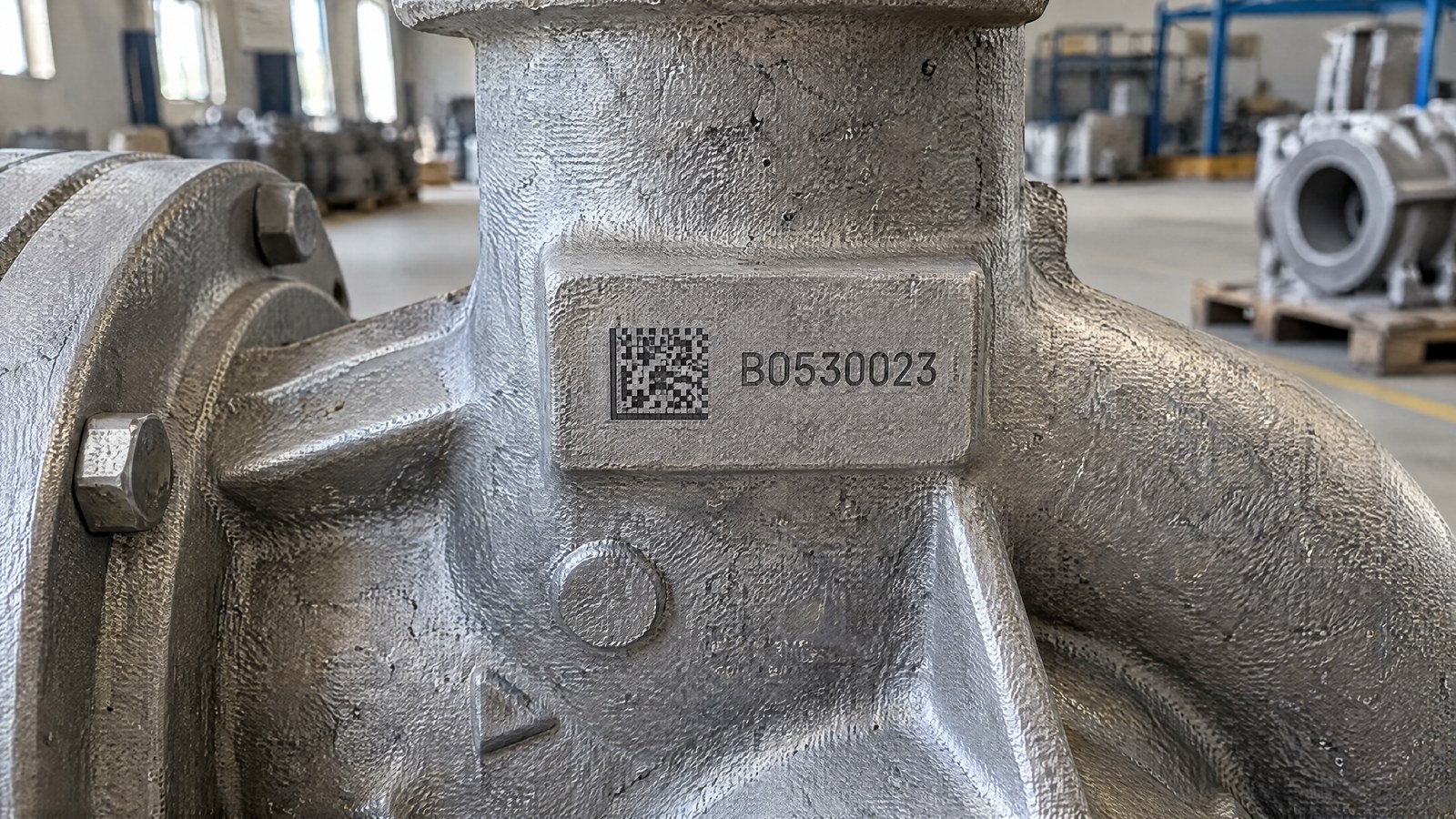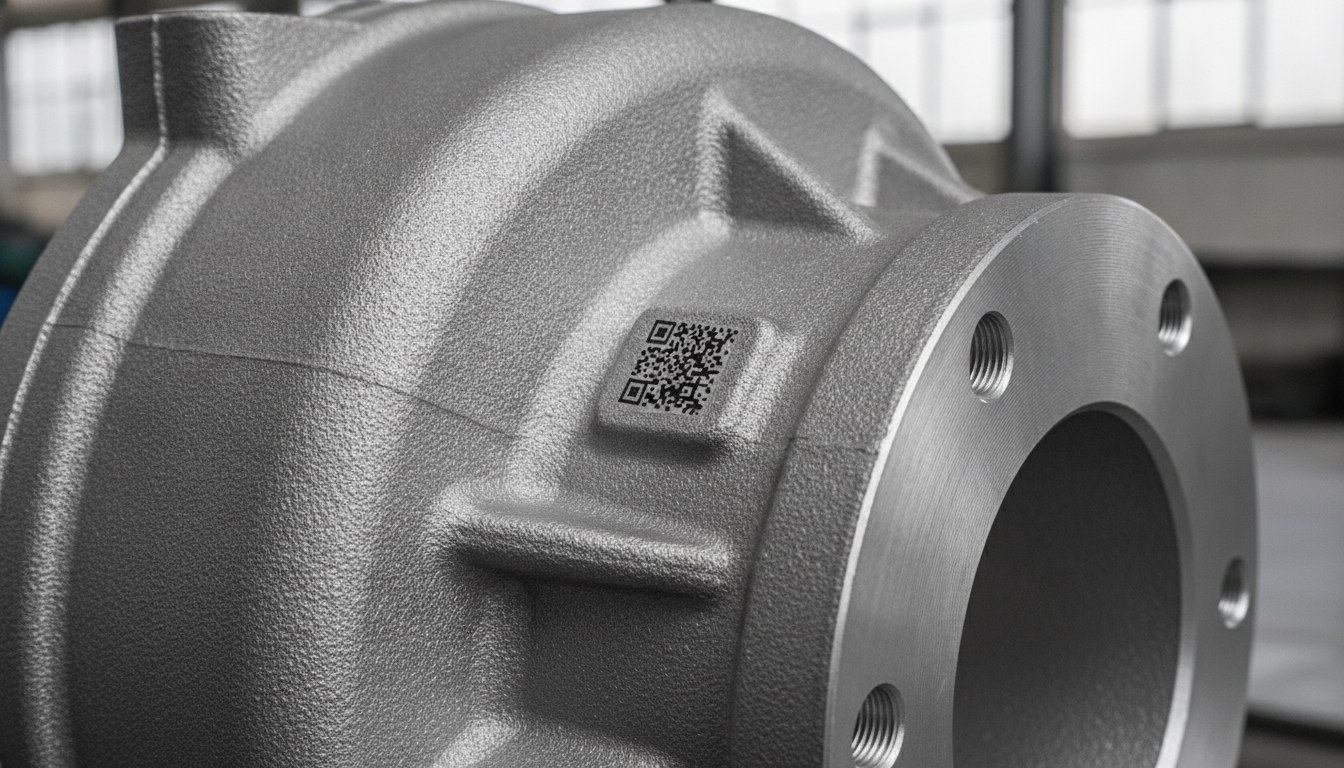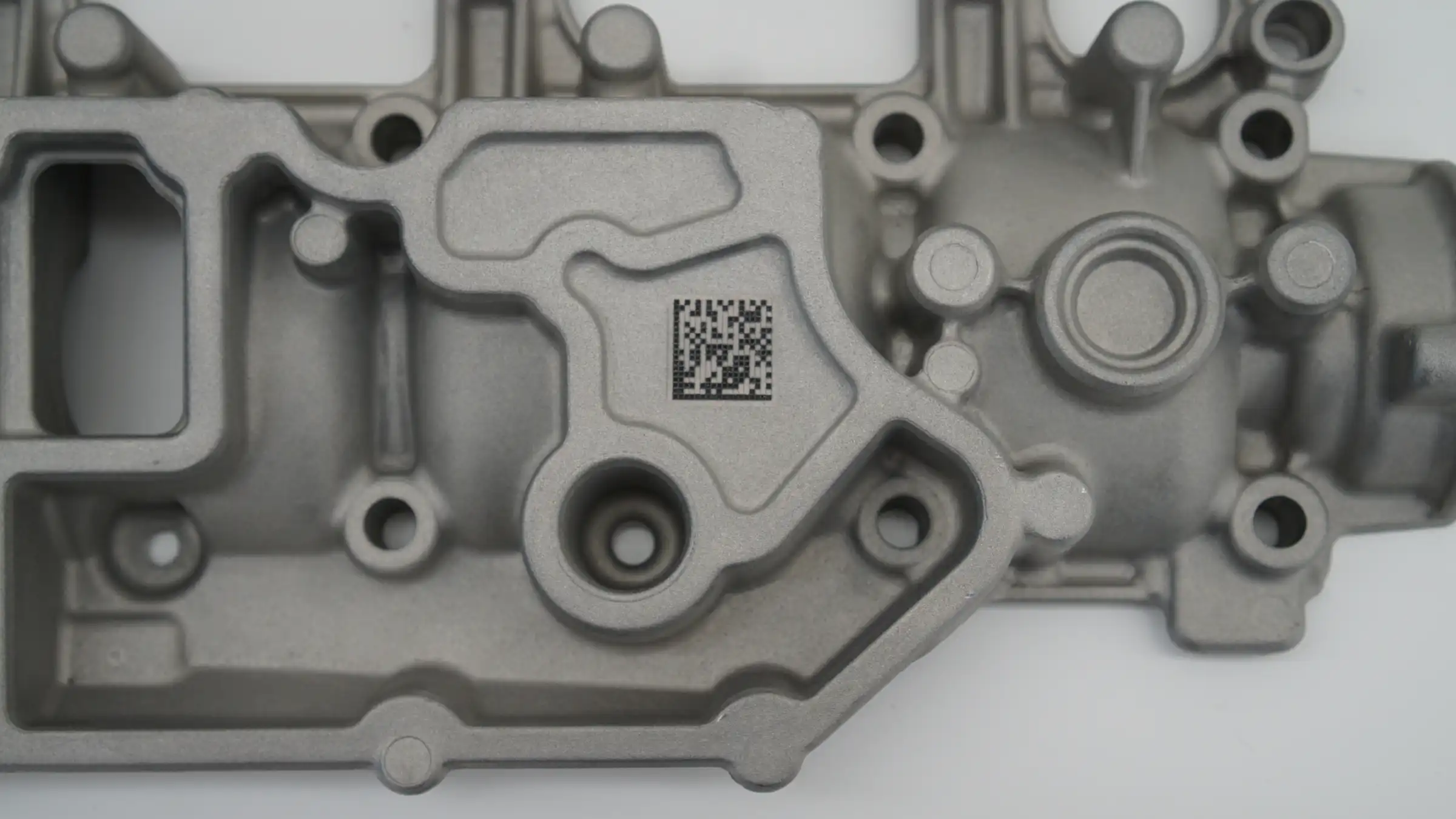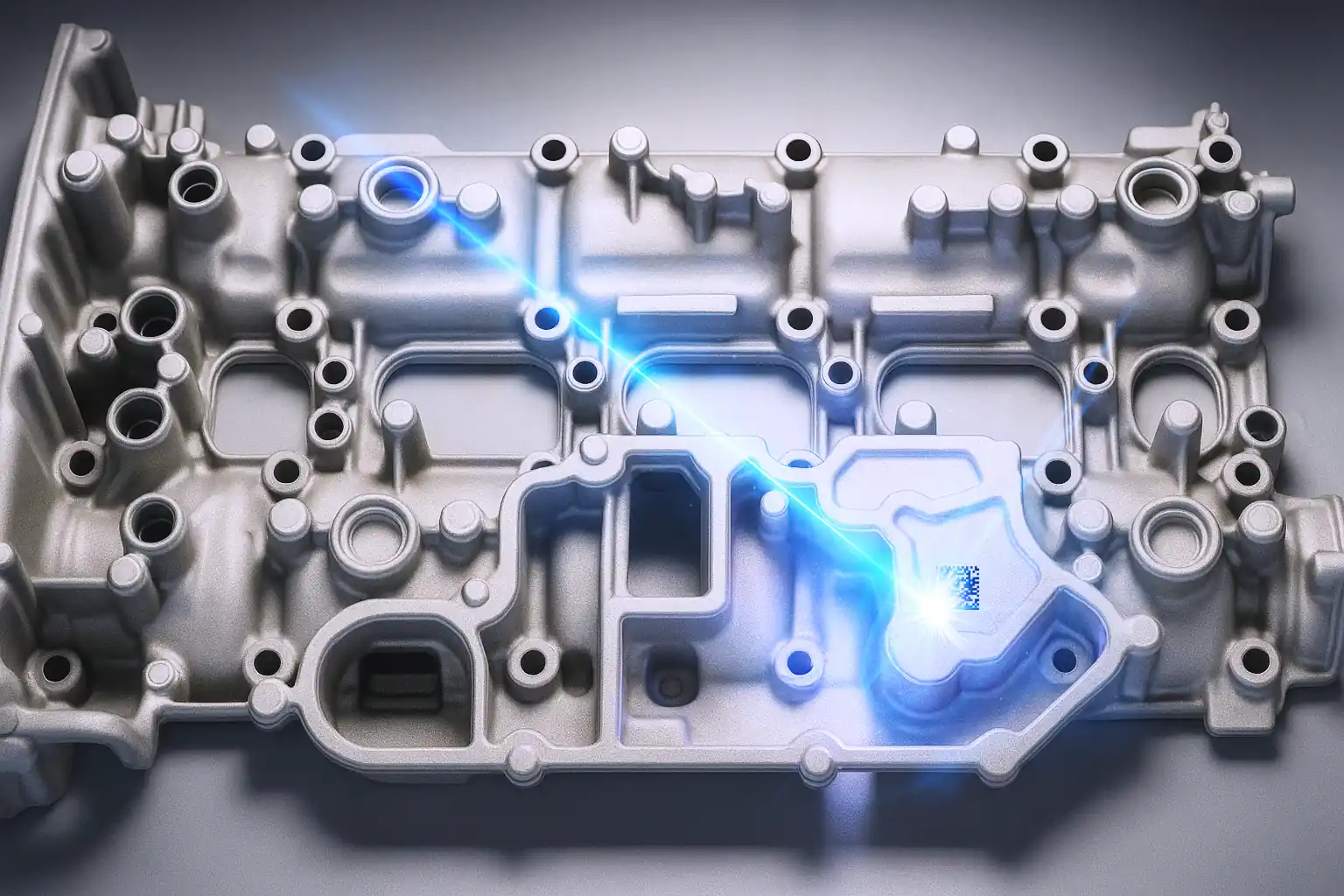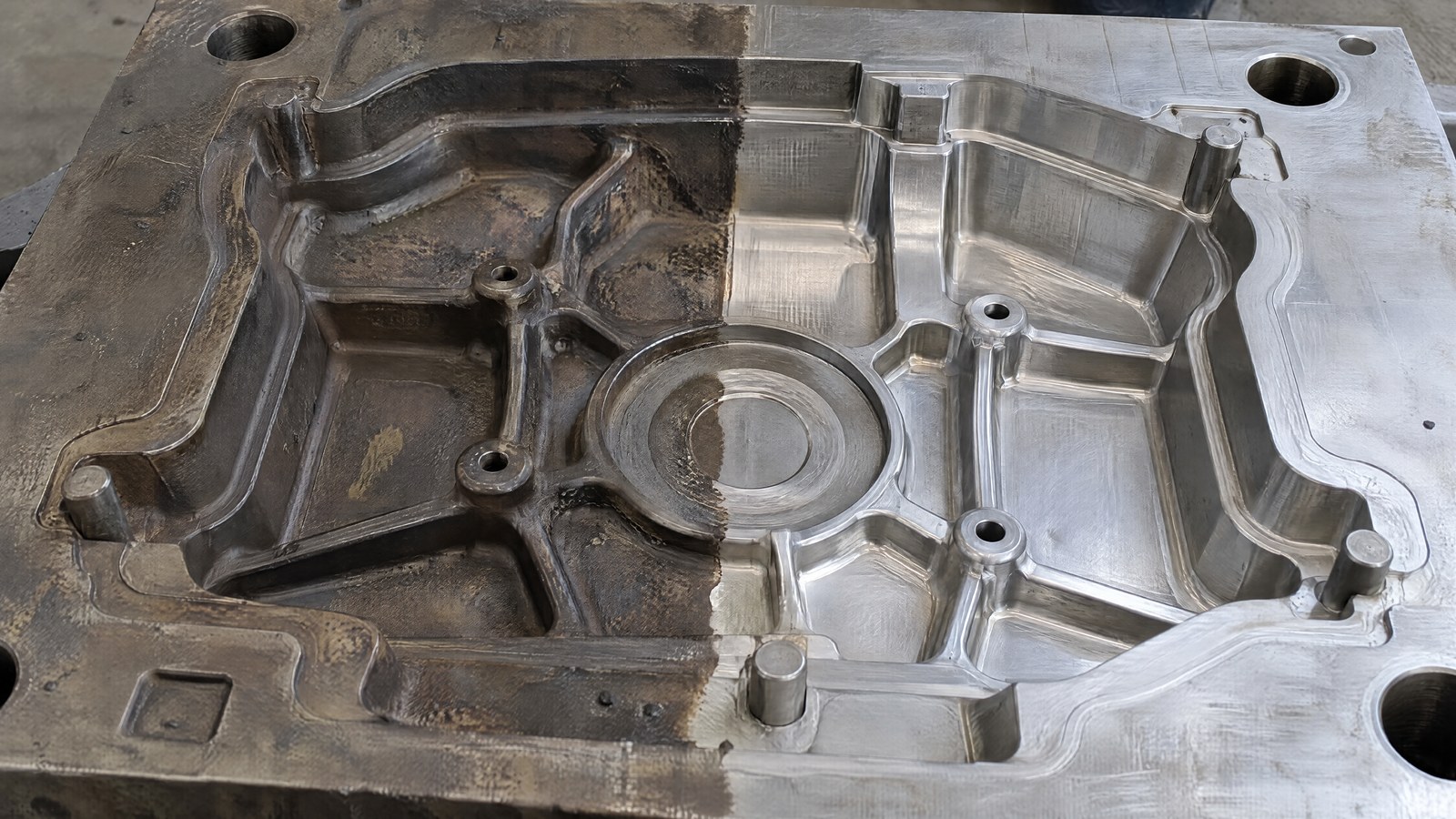
Anyone running a gravity die-casting foundry or a die-casting operation with permanent molds knows the moment when the cavity stops “giving back” the part the way it should. Casting after casting, three different deposits build up on the surface of the mold tool steel: polymerized release agent, which the thermal cycle bakes and turns into a stubborn film; oxides generated by repeated exposure to molten metal; and carbon deposits left by degraded lubricants and release agents. The result is a cavity that loses detail definition, alters the casting finish and, in the worst cases, promotes fill defects or soldering.
Maintenance today almost always takes one of two routes: solvent degreasing, which softens but does not strip the polymerized layer, and micro-blasting, which does remove it but acts abrasively across the entire surface. In both cases the maintenance team pays three prices: the progressive wear of the geometry (every pass of abrasive also removes a fraction of the substrate and rounds off edges and micro-details), poor repeatability (the result depends on the operator’s hand and the grit of the day) and machine downtime, because the mold often has to be removed, taken to a booth and brought back up to temperature.
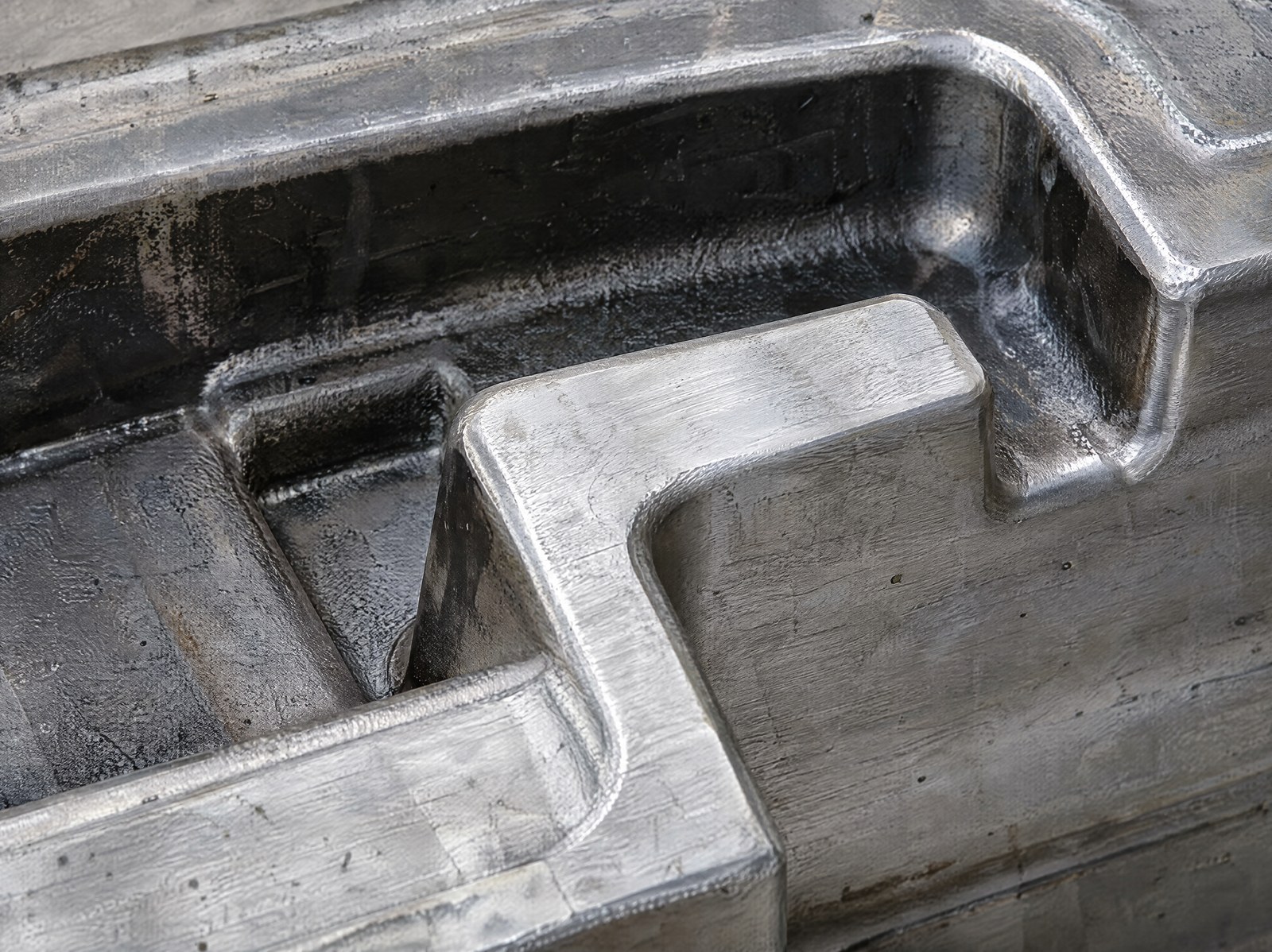
Laser cleaning addresses exactly these three points: it removes the contaminant through selective ablation, without affecting the steel underneath, and it is a repeatable and programmable process, making it suitable for planned preventive maintenance rather than corrective maintenance.
Why release agent, oxides and carbon deposits behave differently
Not all cavity contaminants are the same, and the choice of cleaning method should start here. The release agent, sprayed on at every cycle, polymerizes and builds up under repeated heat: from a thin film it becomes an adherent crust. Oxides are chemically bonded to the surface iron and tend to form in corners and in the areas in most direct contact with the melt. Carbon deposits, finally, are dark and strongly absorbent to infrared radiation. It is precisely this difference in behavior that makes the laser interesting: contaminant and steel have different interaction thresholds with the beam, and selectivity is built on that difference.
How selective ablation works
Laser cleaning works by ablation: a pulsed beam, typically from a fiber source with a wavelength of 1064 nm, is focused and scanned across the surface. The contaminant absorbs the pulse energy and is removed in an extremely short time — vaporized or ejected as microplasma — without the heat having time to propagate deep into the metal.
The principle that makes the process “clean” is the ablation threshold: every material begins to be removed only above a certain energy density (fluence). Polymerized release agent, oxides and carbon have a significantly lower threshold than tool steel, and they absorb infrared far better. By setting the parameters just above the contaminant’s threshold and below that of the substrate, the beam “consumes” the unwanted layer and stops naturally when it reaches the clean metal, which reflects most of the residual energy. In practice the laser removes what it is meant to remove and leaves the rest intact, with no mechanical contact and no abrasive consumables. The operating parameters — average power, frequency and scanning speed — must be tuned to the type of deposit and to the steel.
Why selectivity preserves the cavity’s roughness and dimensions
This is the point a tooling manager cares about most. Micro-blasting, being an impact process, acts indiscriminately on both contaminant and substrate: it removes the deposit but blunts the edges, opens up the roughness and, repeated over time, shifts the cavity’s dimensions out of tolerance. In a precision mold this means losing the definition of the ribs, the lettering and the fillets that characterize the casting.
Laser ablation, acting only on the layer that absorbs the energy, is not abrasive: it does not remove base metal, so the cavity’s roughness and dimensions stay as designed. The surface that re-emerges is the steel’s original one, not a new finish created by the abrasive. This also makes it possible to selectively treat only the contaminated areas, without touching areas that are already clean — something impossible with a jet of abrasive that hits the entire surface. For a broader comparison between the two process approaches, we have devoted a dedicated article to laser cleaning as an alternative to sandblasting.
Repeatability: from corrective to scheduled maintenance
The less visible but more strategic advantage is repeatability. A laser cleaning recipe is a set of saved parameters: scan path, number of passes, power and speed. By recalling the same recipe, cleaning no. 500 is identical to no. 1, regardless of the operator. This turns an operation that is today done “by feel” into a measurable and documentable process, one that integrates well with a preventive maintenance approach at defined intervals: every so many casting cycles the mold receives its scheduled cleaning, before the deposit becomes critical.
This also leads to a reduction in consumables: no abrasives to buy, store and dispose of, no solvents to manage as waste. The laser has no consumable material that touches the mold, and the only recurring service is the extraction of ablation fumes. We apply the same selective-removal philosophy, with different parameters, to the removal of rust and oxides on cutting tools.
A concrete example: polymerized release agent on a mold steel cavity
A typical case is a tool steel permanent mold whose cavity is covered by a dark film of polymerized release agent and a veil of oxide in the hottest corners. With micro-blasting the toolmaker obtained a “clean” surface that was, however, increasingly dull and with micro-details ever less crisp. With laser cleaning the beam scans the cavity and selectively removes the film and the oxide, letting the steel re-emerge with its original finish; the cavity’s edges and engravings stay defined because the base metal is not touched. The treatment time depends on the thickness and extent of the deposit. This type of application is a close relative of those LASIT has long handled in the foundry environment, as illustrated in the articles on laser marking on molds and on marking hot foundry parts.
Who it is designed for (and who it isn’t)
Laser cleaning performs best where the deposit is thin or of medium thickness and distributed over accessible surfaces: polymerized release agent, oxides and carbon patinas on permanent mold cavities and die-casting tooling made of tool steel, where preserving the geometry and the repeatability of the result matter. It is the natural choice for anyone who today suffers from micro-blasting wear or the ineffectiveness of solvents on the polymerized layer, and for anyone who wants to structure a planned preventive maintenance program instead of a corrective one.
It is not, however, the best answer in every case. On very thick, layered contamination the laser has to proceed in multiple passes, and the cycle time can grow to the point where a preliminary coarse removal by other means is more cost-effective. On very deep, narrow cavities or those with complex geometry, where the beam cannot reach perpendicularly or at the proper focal distance, dedicated access, heads with additional axes or multiple setups are needed, and in some cases the cost/benefit ratio does not hold up. As always, the honest assessment is made on the real part: it is the deposit thickness, the cavity depth and the accessibility that determine whether the laser is the right path or just one part of the maintenance process.

Senior Applications Support | LASIT
Senior Applications Support at LASIT for over 10 years, Ciro Ventura is a specialist in laser marking applications for laboratory sample testing. He supports customers and technical teams in evaluating and selecting the most suitable laser solution for their needs.