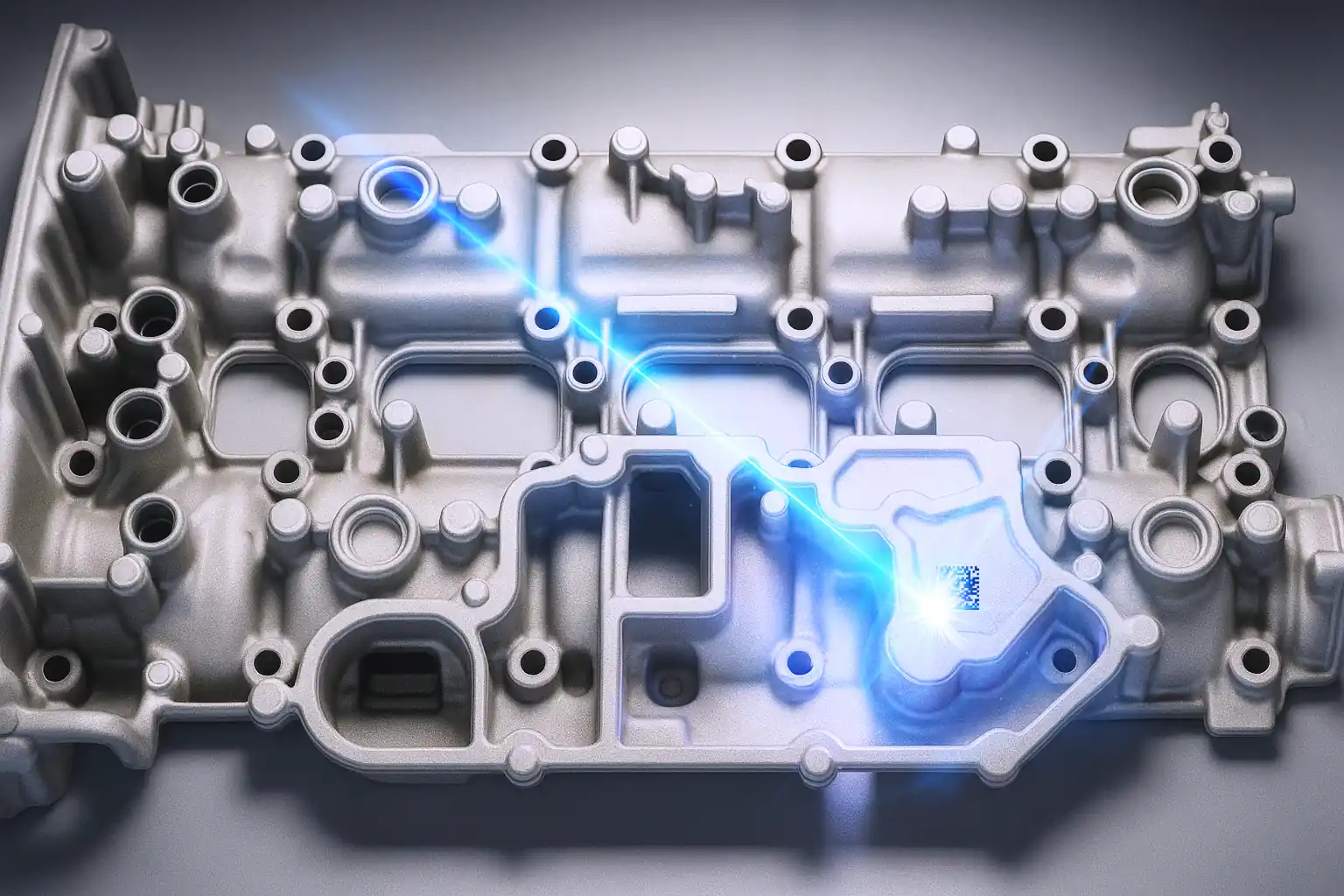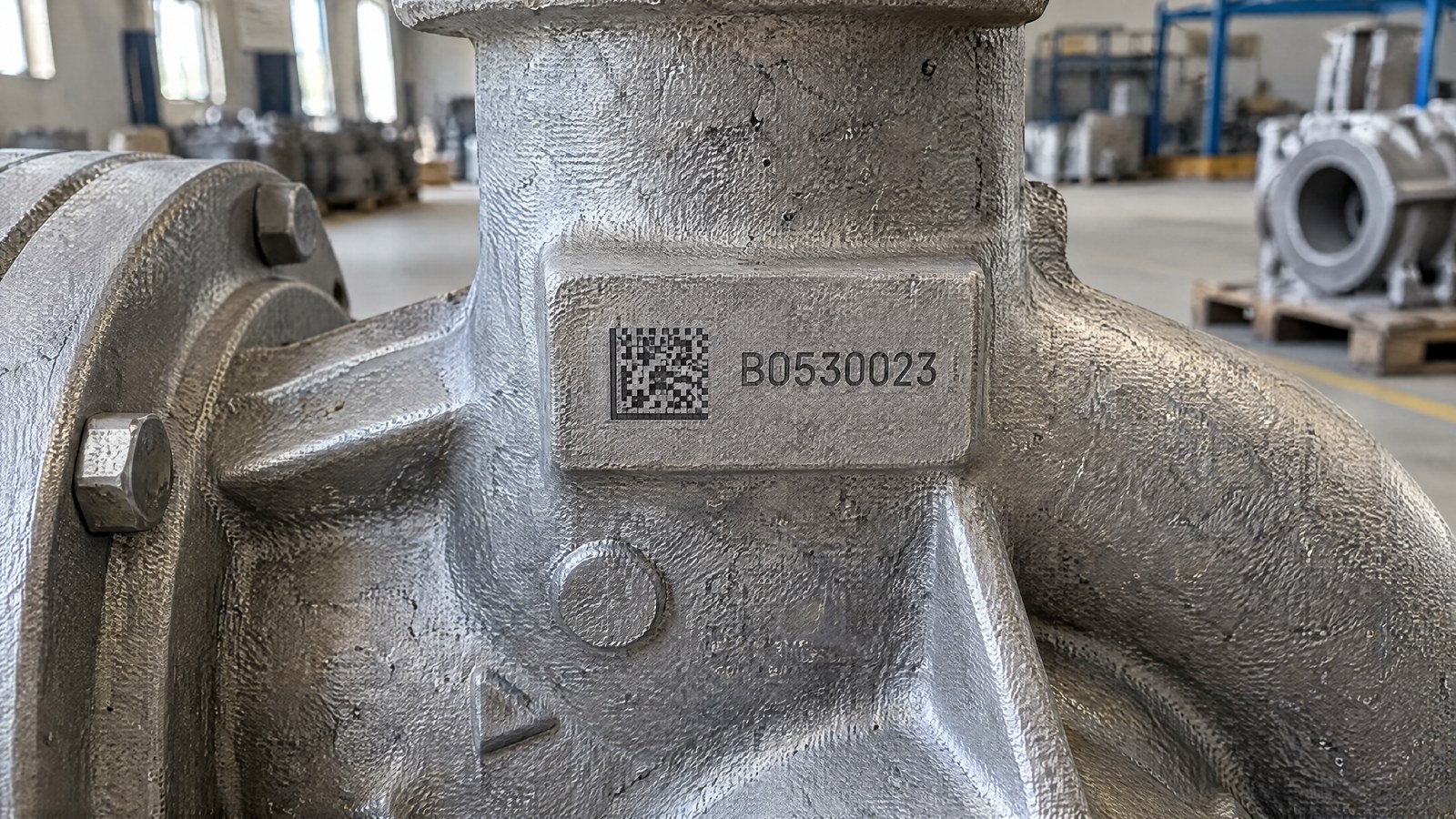
In a foundry the question is not whether to trace the casting, but where to place the mark along the flow: right after shakeout, when the part is still raw and possibly hot, or further downstream, after deburring and machining, on a clean surface. This isn’t an aesthetic choice but a process one: it changes the readability of the code, the depth needed for it to survive finishing and, above all, how much machined value is lost if that part is later scrapped.
Anyone running production knows the trade-off. Marking early means tying the casting to its own pour batch before it gets mixed with the others, but doing so on an irregular, dirty casting skin. Marking late offers an ideal surface for the laser, yet it marks a part on which machine time has already been spent: if it’s scrapped afterward, the machining goes in the trash too. This article lines up the technical factors that determine the correct position of the laser in the foundry flow.
The casting skin: why the raw part is a difficult surface
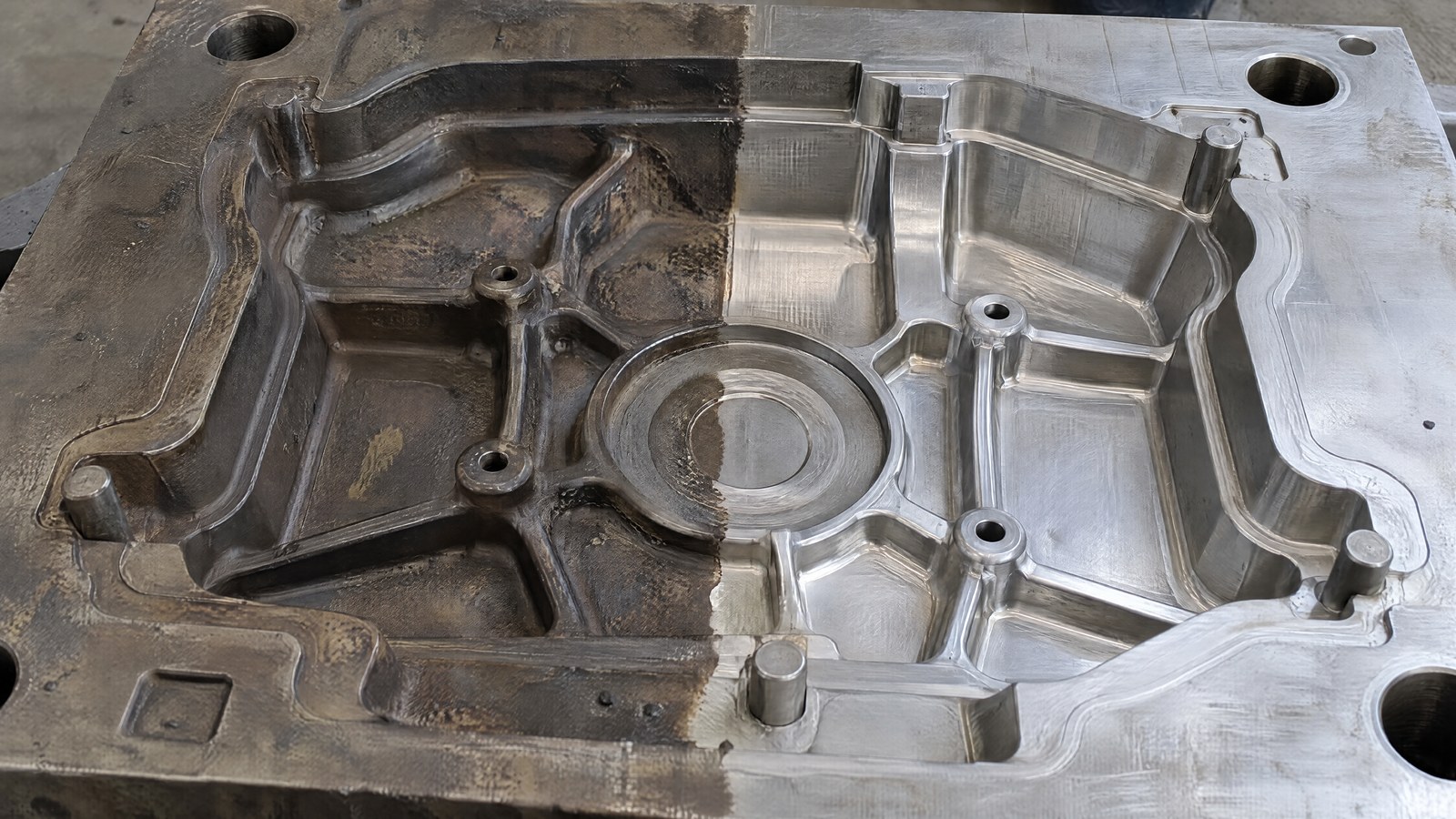
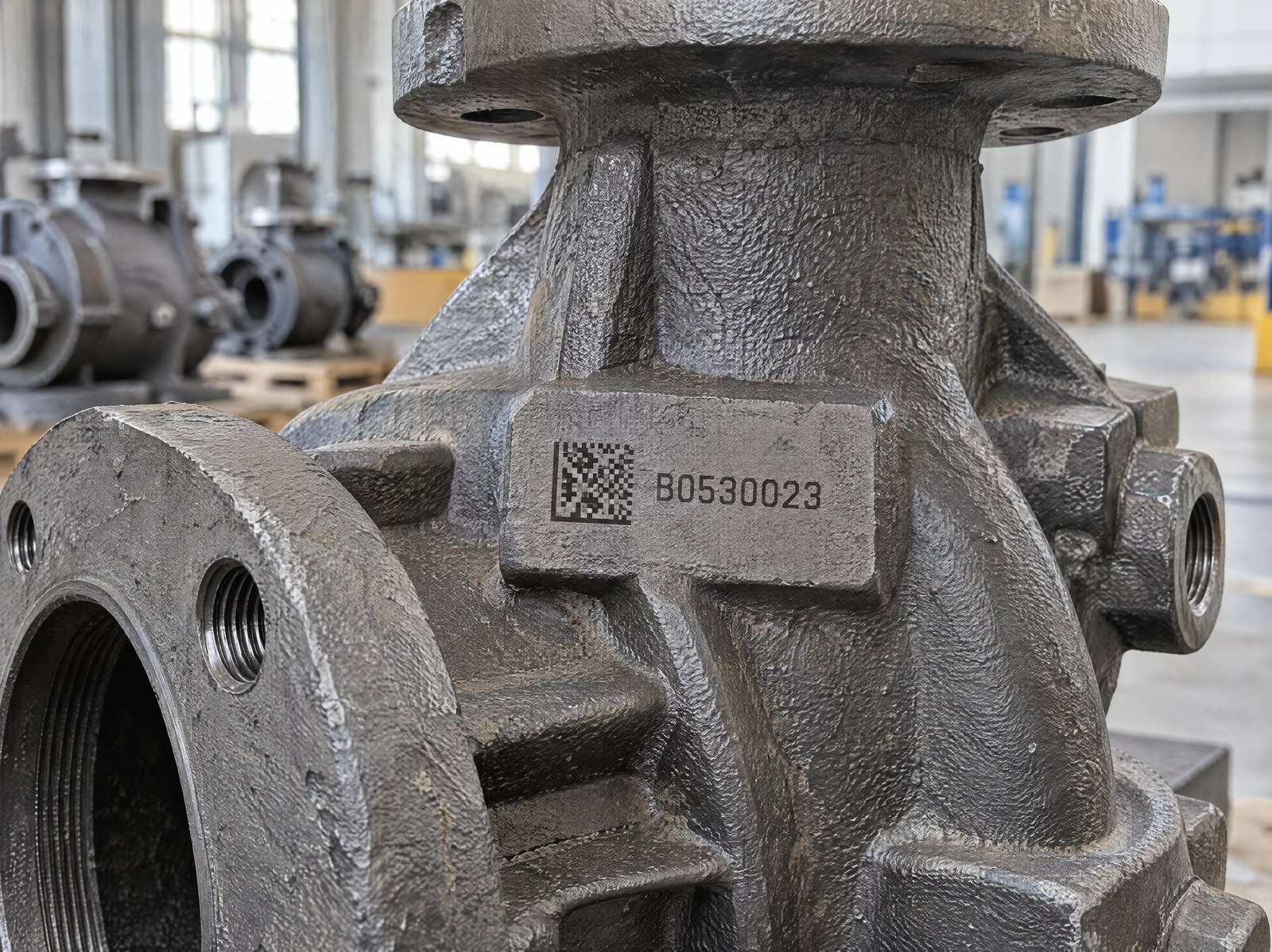
The surface of a freshly shaken-out casting is not uniform. The so-called casting skin is a web of oxides, release-agent residues, embedded sand grains and microporosity, with roughness and reflectivity that change from point to point. When the beam meets it, it finds non-homogeneous material: oxide in one area, nearly bare metal right beside it. The risk is not that the code won’t form, but that its contrast will vary across the matrix, penalizing automatic reading and grading.
For this reason, on the raw part, the goal isn’t optically perfect contrast but code robustness: wide cells, sufficient redundancy, a geometry that stays defined even where the skin is more irregular. The key is to make the DataMatrix readable thanks to the shape of the groove rather than surface color alone, a principle already addressed when discussing marking contrast on the raw part. Quality is then checked with inline grading, which measures the code’s real readability as it is, skin and all.
Usable depth on the raw part: engrave, don’t just mark
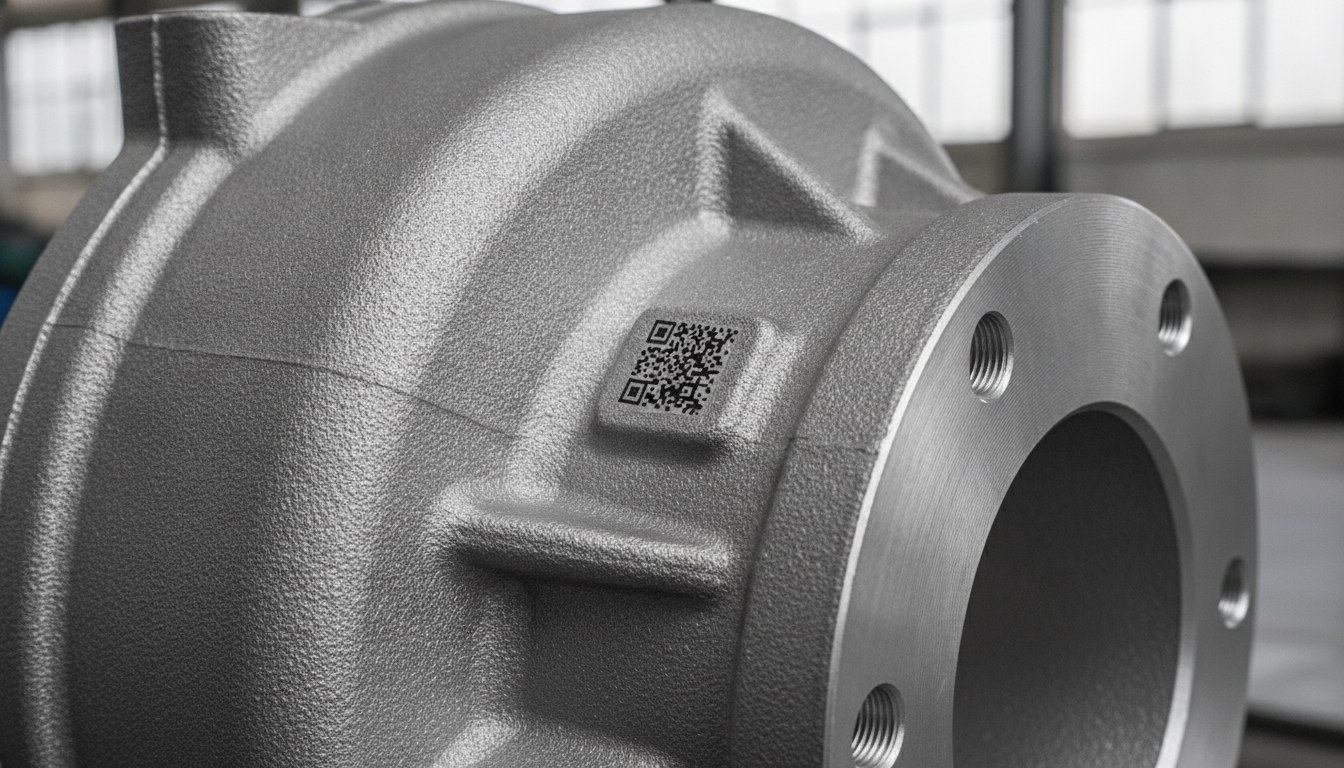
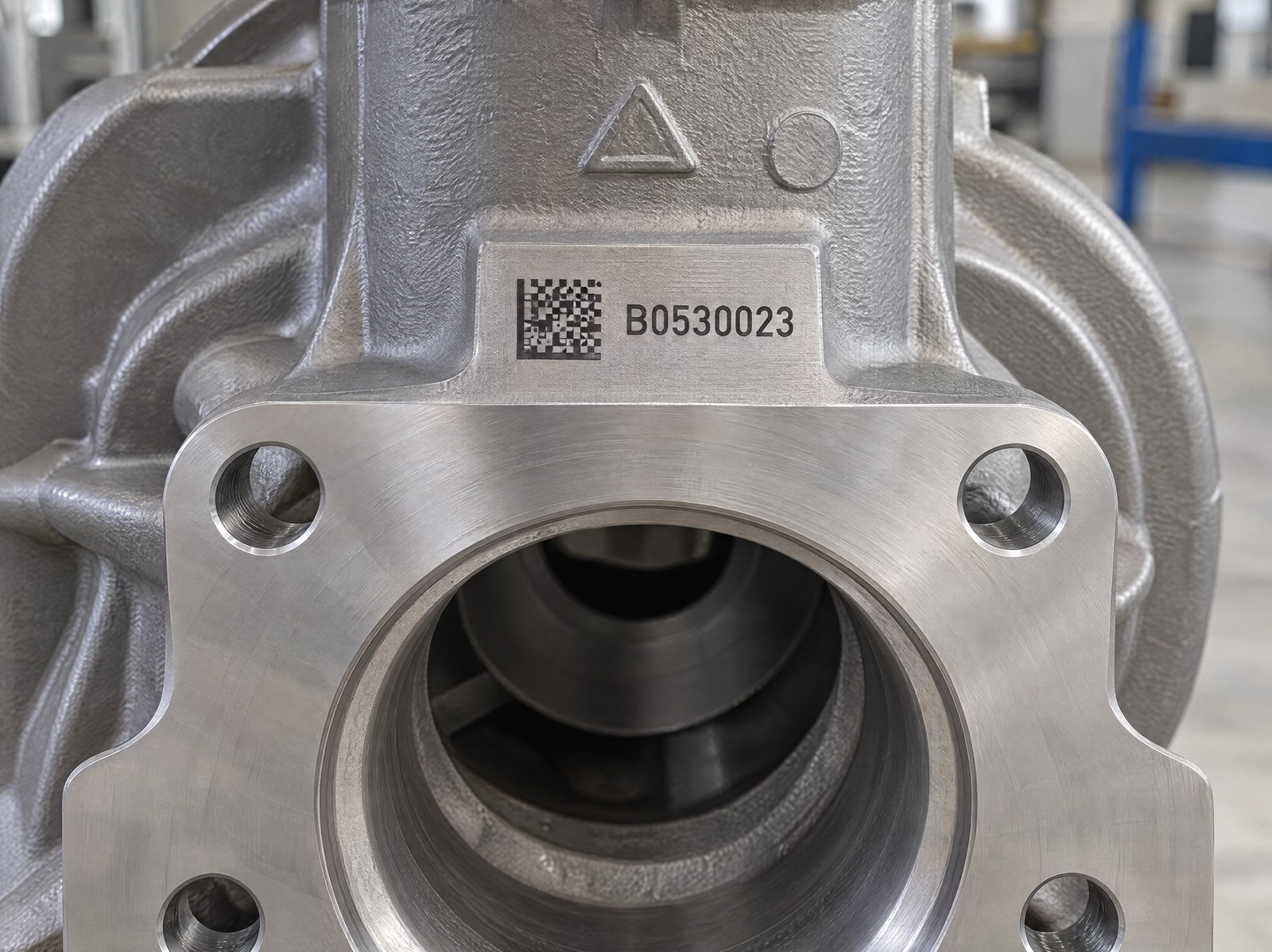
On the raw part the natural technical choice is deep engraving, not surface marking. A 1064 nm fiber source removes material, creating a groove with defined walls, where the code is carried by geometry and not by a thin color alteration. It’s the difference between a mark that lives on the surface and one dug into the metal, able to stay readable even when the outermost layer degrades.
The usable depth is measured in hundredths of an inch, and it must be calibrated to the material: lamellar cast iron, die-cast aluminum and zamak respond differently to the beam, due to porosity, thermal conductivity and oxide behavior. There’s no need to engrave “as deep as possible”: what’s needed is the minimum depth that guarantees reliable reading after all the subsequent operations. Defining it is exactly the job of testing on real samples, where parameterization stops once the code holds up through the full sequence without overdoing cycle time.
Tying the code to the pour batch and the riser
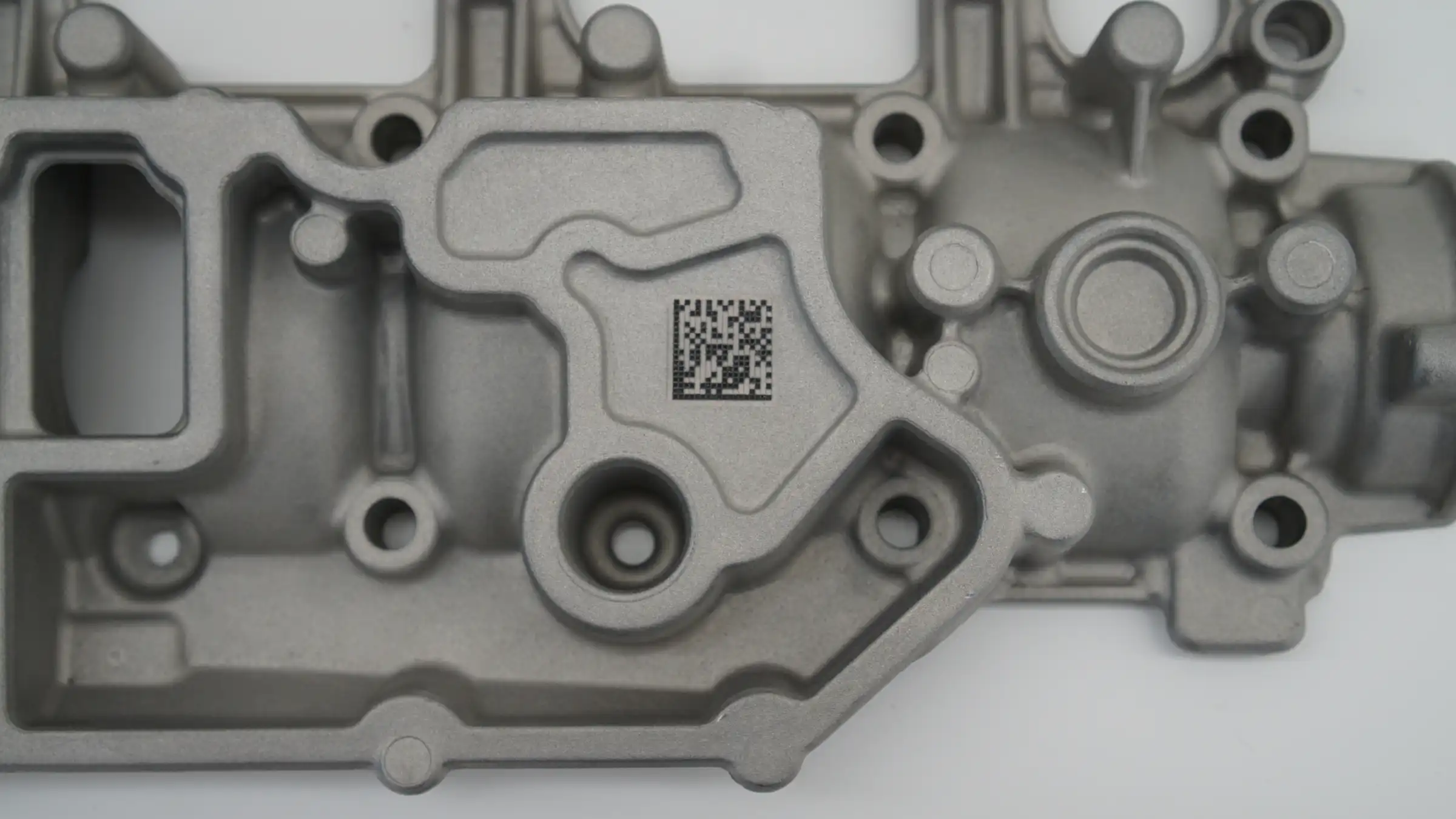
The strongest advantage of early engraving is pour traceability. Marking the casting while it’s still raw allows it to be associated with its batch — mold, flask, pour number, date — before the parts end up mixed together in the downstream bins. A DataMatrix carrying batch and date engraved on the raw part locks this information at the source, where it’s certain, instead of reconstructing it afterward by approximation.
Placement matters. An area near the gate or a technical appendage, such as the riser or a reference boss, offers a more predictable surface for the code and does not interfere with the part’s functions. If that area will be removed during deburring, the code must be placed on a part that remains on the finished component: choosing the spot is an integral part of designing the cycle, not a detail to be decided at the machine.
Deep engraving to withstand sandblasting and shot blasting
After shakeout the casting almost always goes through a surface-finishing step — sandblasting, shot blasting, shot peening — designed precisely to remove casting skin and residues. A shallow mark doesn’t survive: the blast media grinds down the surface layer and carries a light mark away with it. A deeply engraved groove, on the other hand, remains, because the abrasion acts on the surface and doesn’t reach deep enough to erase the dug geometry.
It’s the same reason deep engraving is the right answer when the code has to withstand shot peening and aggressive mechanical treatments. In practice the engraving depth must also be sized according to how much material the finishing will remove: the more energetic the downstream treatment, the more depth margin is needed for the DataMatrix to come out still readable.
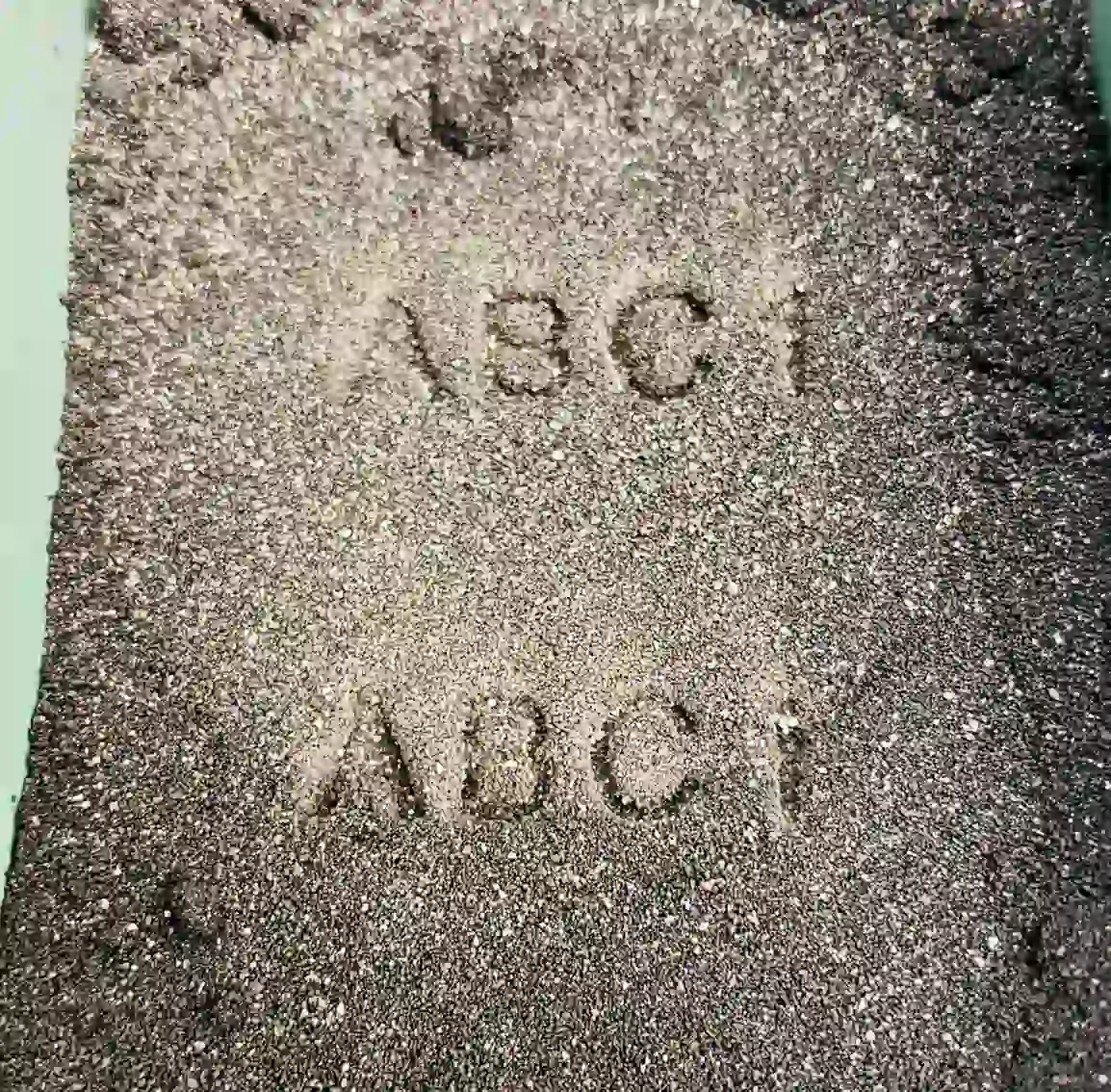
Engraving depth Readability after blasting The deep groove withstands surface removal of the finish.Hot and raw or cold and machined: how to decide
The decision revolves around two variables: the downstream scrap rate and the traceability requirements. If scrap after machining is significant and the part needs to be tied to the pour early, engraving on the raw part avoids spending machining on components that won’t reach the end of the line. If instead the priority is high, uniform readability and the part has a clean machined surface, marking downstream is the simpler path. When the casting is still hot, specific precautions come into play, already discussed regarding marking on hot parts.
There’s no single answer valid for the whole foundry: it changes with the alloy, with the length of the machining cycle, with the added value that accumulates part after part. The chart below sums up the criteria for weighing the two options.
| Criterion | On the raw part (hot) | After machining (cold) |
|---|---|---|
| Surface | Casting skin, non-homogeneous | Clean and even |
| Code readability | Robust but variable | High and uniform |
| Required depth | High, deep engraving | Limited |
| Tie to the pour batch | Immediate | Late, risk of mixing |
| Value lost if scrapped | Only the casting | Casting plus machining |
| Resistance to finishing | Necessary | Less critical |
Who should engrave on the raw part (and who shouldn’t)
Engraving on the raw part pays off for those with long, costly downstream machining, for those who must guarantee pour traceability from the very start, and for those who subject castings to energetic shot blasting: in all these cases early deep engraving protects both the information and the value of the part. It’s the natural choice for cast iron, die-cast aluminum and zamak destined for sectors where the link to the pour batch is a requirement, not an option.
It is not, however, the mandatory path when the component reaches a clean machined surface early, when downstream scrap volumes are negligible, or when the code requires very high aesthetic readability that the casting skin doesn’t allow. In those cases marking after machining, on an even surface, remains simpler and more controllable. The practical rule is just one: place the laser at the point in the flow where the code survives everything that comes after, spending the least amount of machining on parts that might be scrapped.

Applications Manager | LASIT
Applications Manager at LASIT for over 20 years, Mario Palmieri oversees the management and development of the company’s laser laboratory. He is responsible for conducting sample tests for customers, supporting the automotive, medical, aerospace and electronics sectors in identifying the most suitable laser marking solution for their needs.