
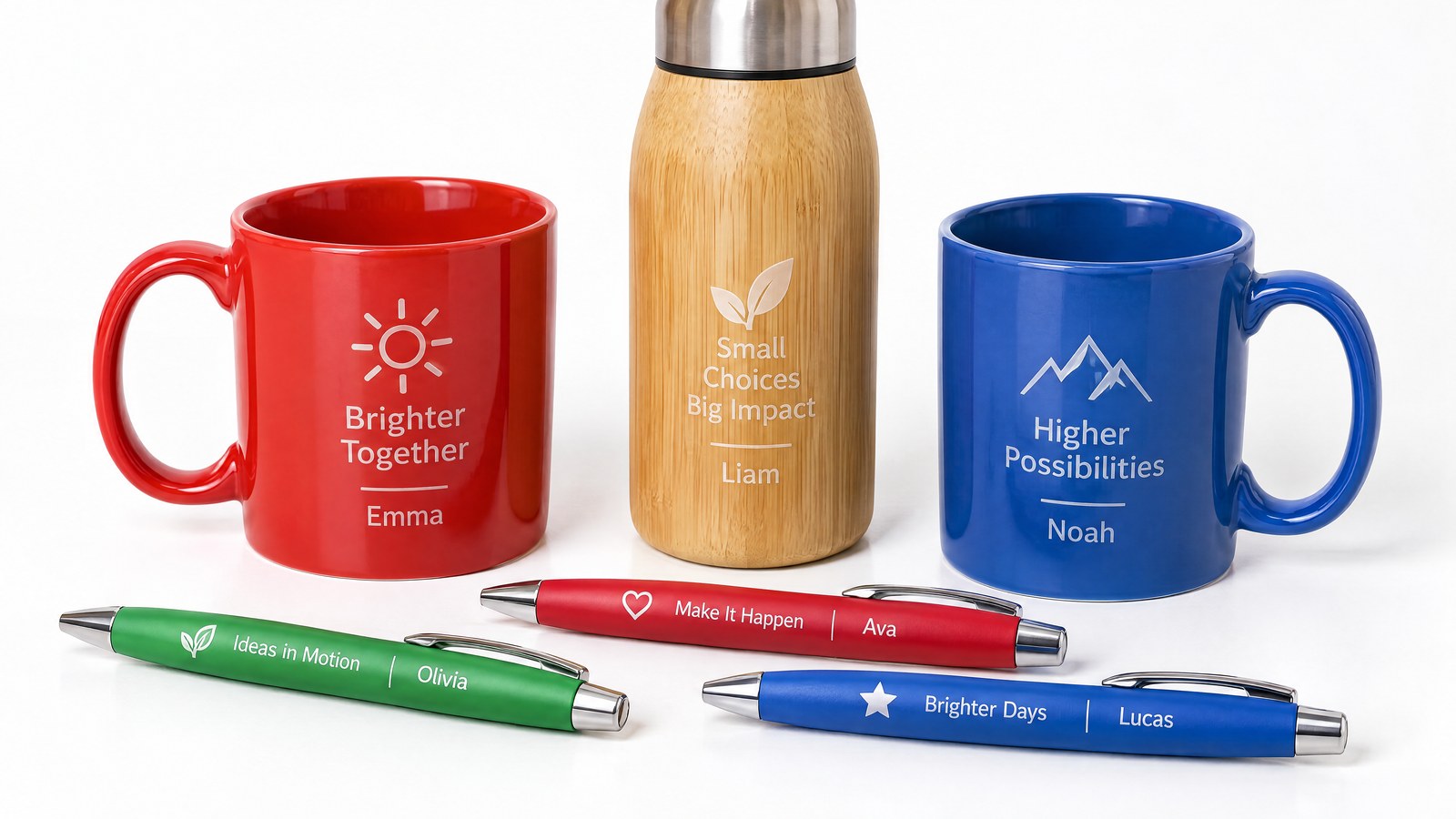
Anyone who makes promotional items knows the scene: a customer approves a sample, then orders ten thousand, and halfway through the job comes the request to add each recipient’s name or change the logo for a second product line. With traditional printing techniques, every graphic change means stopping, re-doing the setup, starting over. The time spent preparing the machine ends up weighing more than the marking itself, and the flexibility the customer takes for granted becomes a shop-floor problem.
Laser marking shifts the balance point. There’s no physical tooling dedicated to a single graphic: changing the design means changing a file. On a well-designed workflow, going from a one-off piece to a run of ten thousand with variable graphics requires no retooling at all. And this is exactly where the thesis of this article comes from: when the laser zeroes out setup time, the bottleneck moves upstream, onto the quality and organization of the data that feeds production.
Why with printing the setup was the bottleneck
In contact printing techniques the graphic lives in a physical carrier: a frame, a cliché, a pad. Preparing that carrier, mounting it, registering it and aligning it takes time and skilled hands, and that time is independent of the number of pieces: it’s the same for one or for a thousand. On long runs that are always identical, it spreads out and pays for itself; on small lots or on graphics that change often, it becomes the dominant item in the cycle.
Every promotional production manager knows the result: small customized series are the most awkward to manage precisely because the cost of a graphic change doesn’t scale. Every variant is a machine stop, and deep personalization — the kind where every piece is potentially different — simply isn’t sustainable with a physical carrier that has to be re-made every time.
The laser zeroes out tooling: from cliché to file
With laser marking the graphic is no longer an object, it’s a digital path. The beam follows the route defined by the FlyCAD management software, and changing the design means loading another layout. There’s nothing to disassemble, clean or register between one graphic and the next: the time that setup used to require simply no longer exists.
This flips the logic of lots. The one-piece series and the ten-thousand-piece series use the exact same machine setup; all that changes is the content to be marked. The mark is also obtained directly on the material, with no inks or printing consumables to manage and align — an advantage we already covered when discussing direct marking versus inkjet printing. The repeatability is that of a software-controlled process: the ten-thousandth piece comes out with the same contrast and the same position as the first.
One-to-one personalization: when every piece is different
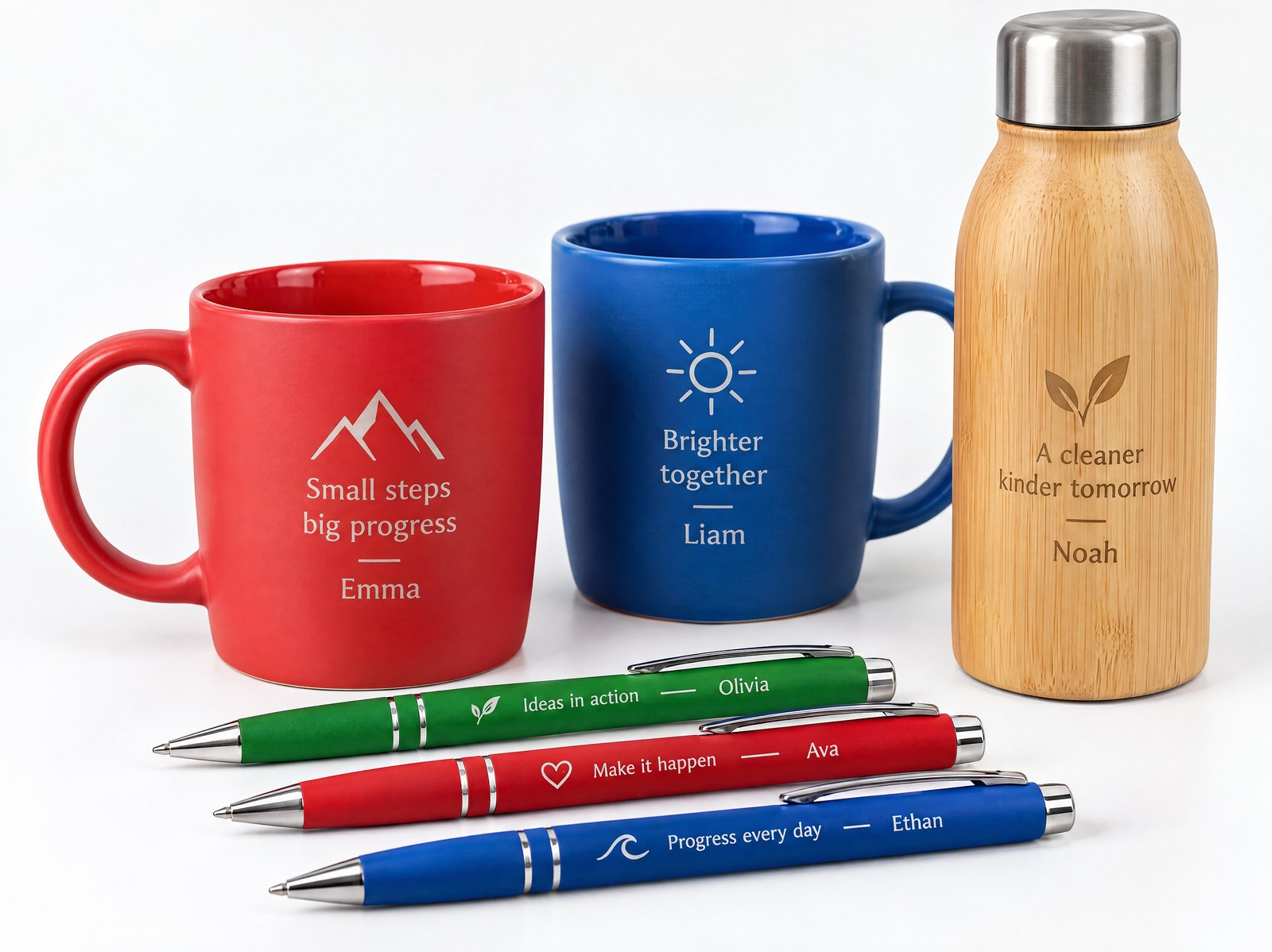
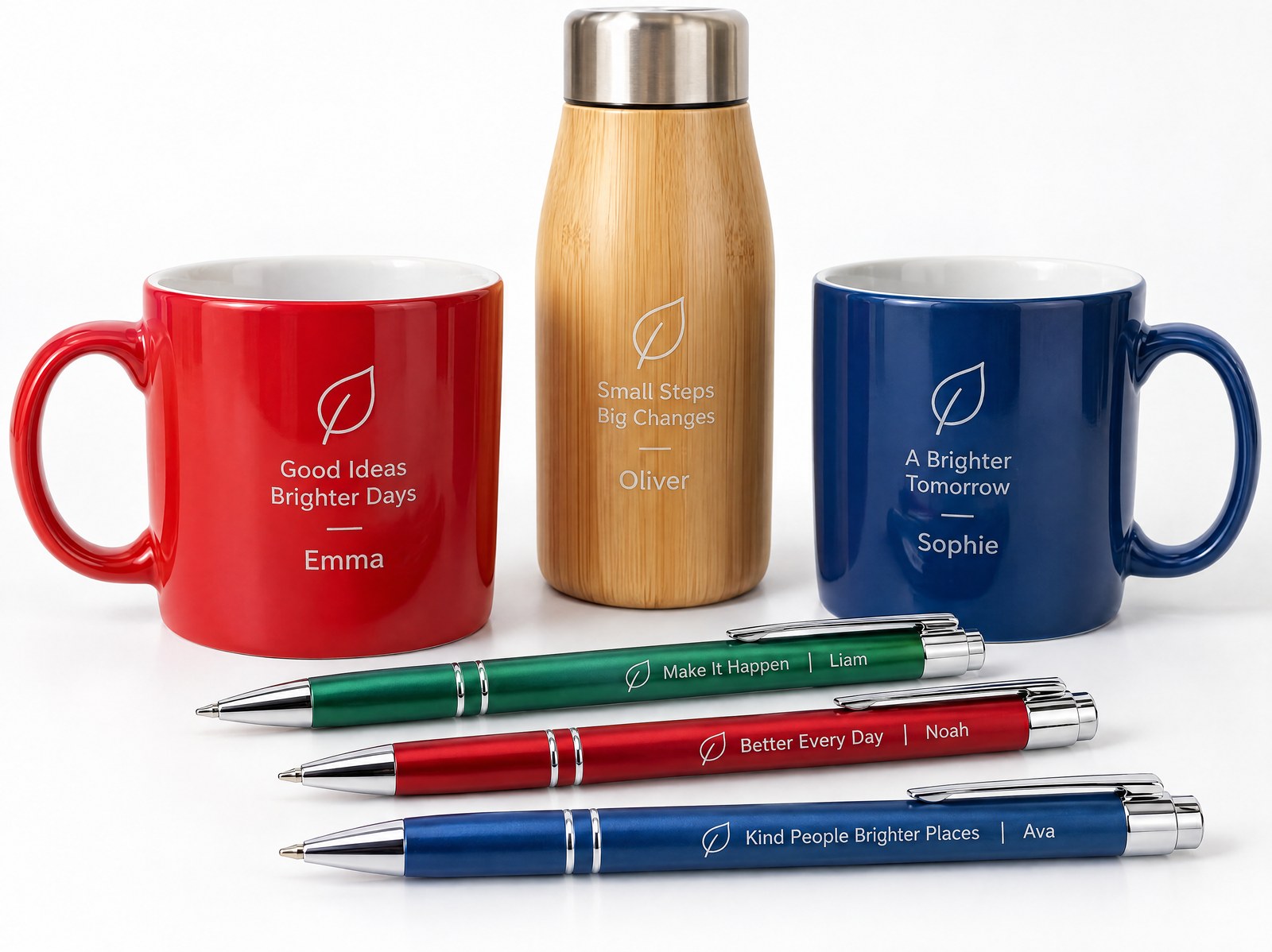
The most interesting consequence is mass customization. If every marking is defined by a file, nothing stops that file from changing with every piece. FlyCAD can read the data to pull piece by piece from a list or an external database: a variable text field — a name, a sequential number, a city, a code — is automatically swapped in on every cycle, while the rest of the layout stays fixed.
From data to custom objectFile or databaseFlyCAD layoutPiece-by-piece markingUnique graphics on each objectIn practice you set up the layout once, connect the data source, and the machine marks ten thousand all-different objects in sequence without anyone touching the graphic from one piece to the next. It’s the same principle we use to manage serial marking in industrial traceability, applied this time to aesthetic output: here the variable field isn’t a lot number, it’s the name of the person who will receive that water bottle or that pen.
The new constraint is called data management
If tooling disappears, the limit shifts. The real bottleneck of one-to-one personalization is no longer the machine, it’s the quality of the data record that feeds it. A list with names written inconsistently, accented characters not handled, fields too long for the available space, or duplicate rows turns into just as many pieces to rework — and on a customized run an error in the data is an error marked permanently.
That’s why a well-set-up personalization project devotes attention upstream to a few concrete points:
- consistency and cleanliness of the starting list or database, with clear rules on lengths and allowed characters;
- definition of the marking area and the behavior of the variable text when a name is longer than average;
- order and correspondence between the sequence of the data and the physical sequence of the pieces in the machine;
- a read check or visual verification when the marking includes codes meant to be read back.
These are preparation activities, not shop-floor ones: once they’re set up, production flows. But that’s where a customized job is won or lost today.
Drinkware and 3D objects: large field and prescan head
Many promotional items aren’t flat. Water bottles, tumblers, insulated bottles and other drinkware articles have cylindrical or curved surfaces, often to be marked over a fairly large developed area. This is where scan heads with prescan come into play, focusing the beam even on surfaces at variable height while keeping a sharp mark where the distance changes.
On the larger working fields the solution isn’t prescan alone, but a hybrid XY + prescan configuration: the axes move the object or the head to cover the entire surface, while prescan handles the depth variations within each zone. It’s the same principle we described when discussing the use of the prescan head on the larger working fields: the graphic stays uniform from edge to center, with no blurred or fading-contrast areas.
One laser, many materials: glass, wood, plastic, metal
The promotional catalog is heterogeneous by nature: the same collection can include a steel bottle, a wooden keychain, a plastic accessory and a glass gadget. They don’t all react to the same light, and the choice of source follows the material: fiber works well on metals, UV is the most delicate technology on sensitive plastics and on glass, CO₂ is at home on organic materials like wood.
The relevant point for anyone managing a promotional line is brand consistency across different materials: the same logo must read with the same quality on surfaces that respond differently. We put together the comparison of the different laser technologies on promotional materials precisely to guide this choice case by case, based on the object and the desired effect.
Where screen printing and pad printing remain the right choice
The laser isn’t the answer to every promotional job, and it’s worth saying so clearly. When the project calls for solid-color fills, gradients or large fills, screen printing and pad printing were born for that and remain the reference technologies. The same goes for large always-identical runs on flat surfaces: where the graphic never changes and volumes are very high, the physical carrier of printing pays for itself and becomes very competitive on time per piece.
Laser marking is at its best in the opposite situation: lots that change often, one-to-one personalization from a file or database, three-dimensional objects and mixed materials, the need for a permanent, consistent mark without consumables. In short, if your problem is moving quickly from one piece to ten thousand with variable graphics, the laser removes the constraint from tooling and hands it back where you can really govern it: in the quality of the data. If instead you have to cover thousands of identical pieces with color, traditional printing continues to be the more rational path.

Senior Applications Support | LASIT
Senior Applications Support at LASIT for over 10 years, Ciro Ventura is a specialist in laser marking applications for laboratory sample testing. He supports customers and technical teams in evaluating and selecting the most suitable laser solution for their needs.


