TowerTag: automatic laser tag marking with configurable loaders and ERP integration

Laser tag marking with TowerTag: configurable loaders, vacuum pick&place, carousel or belt unloading, and ERP/MES integration for production

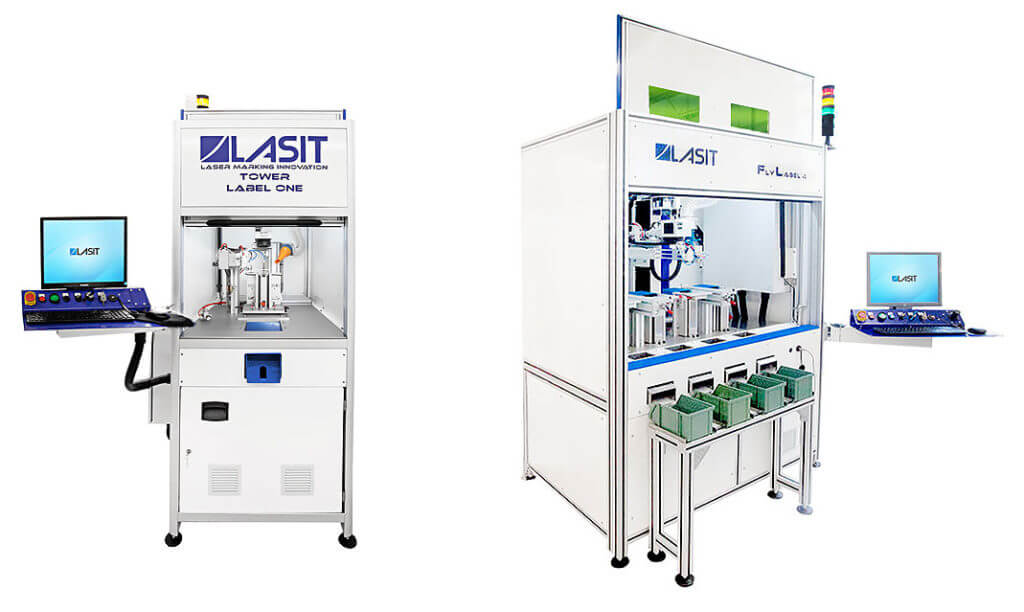
The TowerTag is LASIT’s laser marker dedicated to the automatic marking of industrial nameplates. It was created for those who produce hundreds or thousands of nameplates per day-typically made of anodized aluminum, stainless steel or brass, with thicknesses from 0.3 to 1.5 mm-for application to valves, pumps, electric motors, gearboxes, filters or other large components, where directly marking the finished product is impractical or inefficient. The machine is Class I, with fiber laser source (in standard fixed-pulse or MOPA variable-pulse versions) and typical marking area of Ø220 mm with FFL254 focal length. What sets it apart is its modular architecture: loaders configurable in number and format, vacuum pick-up system, and an extensive range of unloading solutions, from the simplest chute in a tray to external unloading stations with rotary table or conveyor belt.

Loaders: one to four, fixed or adjustable

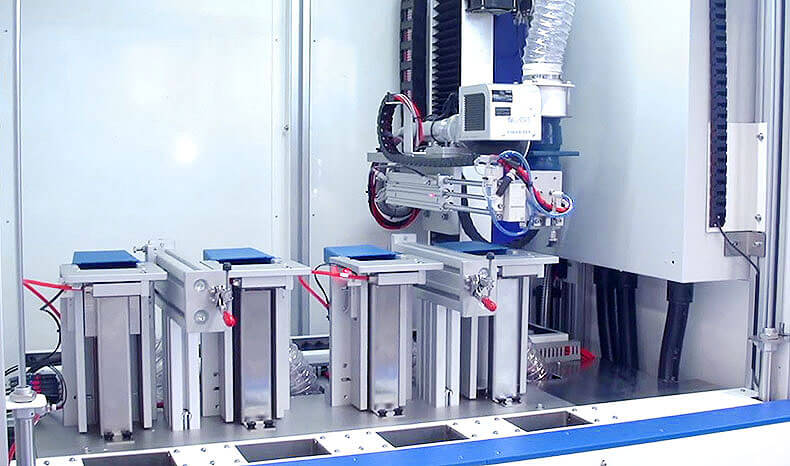
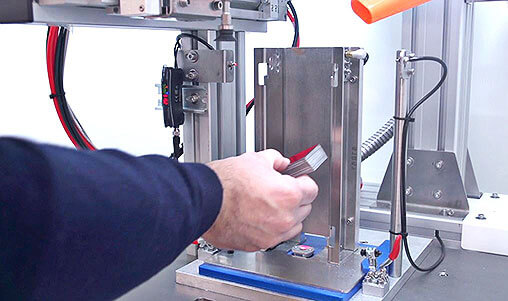
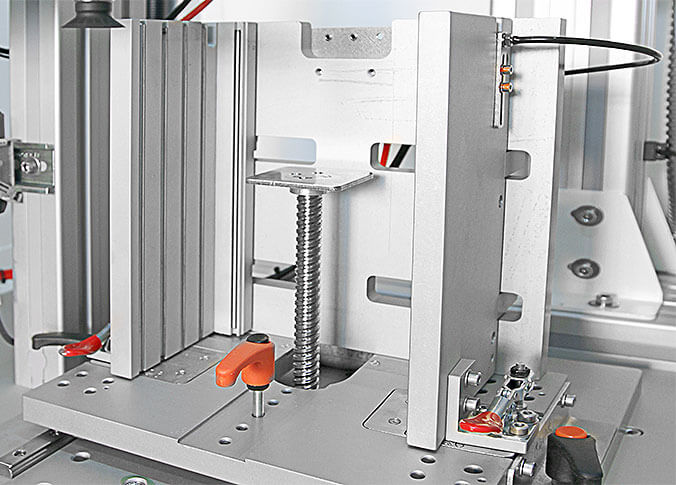
The loaders are the productive lung of the machine. The TowerTag can be set up with one to four loaders, each with a vertical stroke of 200 mm and capacity for up to 400 0.5-mm-thick plates. The stack advances upward thanks to a screw driven by a motor with an integrated encoder at 2,048 steps/revolution: two end-of-stroke sensors detect the plate in the pick-up position and the advance stops only when it is actually ready. This choice-servocontrolled rather than fixed limit switch-allows plates of different thicknesses to be handled successively without intervening in the mechanical parameters, because it is the position control that closes the loop.

Loaders can be fixed, sized to a single plate format with reduced guide tolerances, or adjustable, with repositionable guides to accommodate different formats without machine downtime. The choice depends on the production mix: those who process a single format, or a few formats with frequent changeovers, benefit from the precision and loading speed of fixed loaders; those who handle many formats with recurring changeovers find adjustable ones the most flexible solution. In both cases, geometry and loader equipment are defined at the design stage on the customer’s actual formats, from the smallest plates (typically 30 × 15 mm) to formats around 100 × 60 mm.

Venturi vacuum pick & place

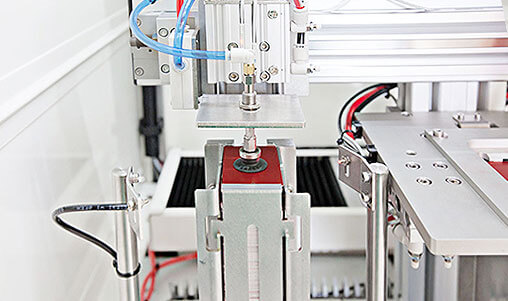
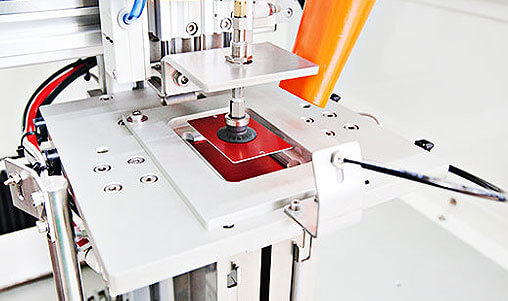
The plate is picked up by a Venturi vacuum suction cup, gripping from above and moving on a pneumatic axle. It is a choice that has a precise motivation compared to the pneumatic pushers widespread on the market: the pusher works well on thick and perfectly flat plates, but on thin plates or on already finished plates-anodized, painted, satin-finished-the risk of scratches from dragging and jamming due to misalignment of the stack is real. Vacuum gripping negates this critical issue: the nameplate is lifted without creeping on the others, even with very low thicknesses and normal dimensional tolerances, without requiring prior part selection. The geometry of the suction cup, like that of the loader, is sized to the plate format-a relevant detail when machining small plates or when there are through holes that would interfere with suction.

Towerlabel-sistema-pick-and-place TowerTag: automatic laser tag marking with configurable loaders and ERP integration

Offloading: from basic solutions to complete outdoor stations

Unloading options are where TowerTag’s configurability is most widely expressed, because this is where production needs diverge most between customer and customer.

Disorderly discharge is the basic solution: the marked tag is released onto a chute that conveys it to a collection tray. It is appropriate when marking homogeneous batches, or when the exit sequence is not significant for downstream stages. It is the most compact and economical configuration.

Scarico-disordinato-1024x742 TowerTag: automatic laser tag marking with configurable loaders and ERP integration

Orderly unloading, on the other hand, involves a dedicated loader at the outlet, where marked plates are stacked in the same order in which they were processed. It becomes essential when each tag is unique-bearing a serial number, a Datamatrix, data tied to a specific customer order-and must maintain correspondence with the production list. Typical configurations are 1+1 (one loader loading, one unloading), or 2+2 when volumes are higher and continuous feeding on both sides is desired.

Scarico-Ordinato TowerTag: automatic laser tag marking with configurable loaders and ERP integration

When batches need to be physically separated by customer order, product code, or destination, external unloading stations are used. The first solution is the rotating carousel with drawers, positioned externally to the machine: the nameplate is channeled onto a chute that deposits it into the preselected drawer, and the carousel rotates to index the next drawer. Typical configurations involve 12, 17 or more drawers, with dimensions (typically around 75 × 120 × 90 mm) sized to the average batch handled. Positioning is motorized with built-in encoder to ensure repeatability, and the operator can pick up completed drawers even during the work cycle without interrupting production. It is the preferred solution when handling many small- to medium-sized parallel orders.

The second solution is the conveyor belt with indexed trays. The trays slide under the discharge point, and the machine indexes them according to the order-tray mapping managed by the software. This is the most suitable configuration when batches are large and an extendable discharge line is desired, or when additional operations- filming, tray labeling, robotic picking-are to be integrated downstream. Again, the picking of completed trays takes place without stopping the machine.

For applications that require surface protection of the marking, the TowerTag can be complemented with an integrated pellicle module: after marking, the tag is deposited on the base of the pellicle, a roll-fed clear film is dispensed and applied under pressure by pneumatic cylinder, and the pellicled tag is then conveyed onto the outlet. It is useful on plates intended for aggressive environments, where the marking, although deep, benefits from protection against abrasion or contaminants.

Other frequent accessories include the pneumatic nameplate rotation system in the marking zone-useful when marking on both sides without manual intervention, with 0-180° rotation in Masked time-and the internal suction systems with HEPA H14 filtration and activated carbon, which are indispensable when marking materials that produce fumes or microparticles, both to protect the laser optics and the quality of the working environment.

The software: dialogue with ERP/MES and dynamic order management

On a mechanical level, TowerTag does what is asked of it. The real added value, especially on high volumes and mixes, lies in the management software. At the base are FlyCAD for layout generation-text, Datamatrix conforming to ISO/IEC 16022, QR conforming to ISO/IEC 18004, vector logos, progressive serials-and FlyControl for machine cycle management. On top, in almost every real project, a custom application (TagMarker or equivalent) is added that puts the marker in dialogue with the company ERP or MES.

FLYMES_software-1-1024x482 TowerTag: automatic laser tag marking with configurable loaders and ERP integration

The typical scheme is as follows: the production office generates an order, the ERP exposes it in a border table (CSV file, database query, exchange via OPC UA or REST), TowerTag’s software reads the order, retrieves for each row the correct layout and variable fields (serial number, product code, lot, date, CE mark), and marks the required quantity. The unloading logic-sorted, on a carousel, or on a belt-then reflects the order structure: each tag ends up in the correct drawer or tray without operator intervention. A single cycle can include plates of different products, with different layouts, handled in dynamic sequence.

Selection criteria

The configuration is sized on three variables: production volume (how many plates per day, what peak), variety of formats (how many distinct formats, how frequent changes), required unloading mode (single batch, ordered sequence, separation by order). On 50 to 300 plates per day and one or two stable formats, a single-loader TowerTag with disordered unloading is already sufficient. On higher volumes with mixed orders, the 2 or 4-loader configuration with orderly unloading is the natural choice. When parallel orders need to be kept physically separate, external stations with rotating carousel or belt become the natural complement, always integrated via software with the customer’s management system.

Post content

Learn how our solutions can transform your processes

Related Articles

Laser marking of pumps and valves with 3D head: how to overcome the limitations of complex surfaces

Read more >

Laser marking of valves and pumps: the Rotomark rotary table as a process platform

Read more >

Laser marking of nameplates in hydraulics: why interface software with MES/ERP makes a difference

Read more >

Laser Marking on Name Plates: Technical Solutions for Industrial Traceability

Read more >

Valvole Italia – Advanced Traceability in the Hydraulics Sector

Read more >